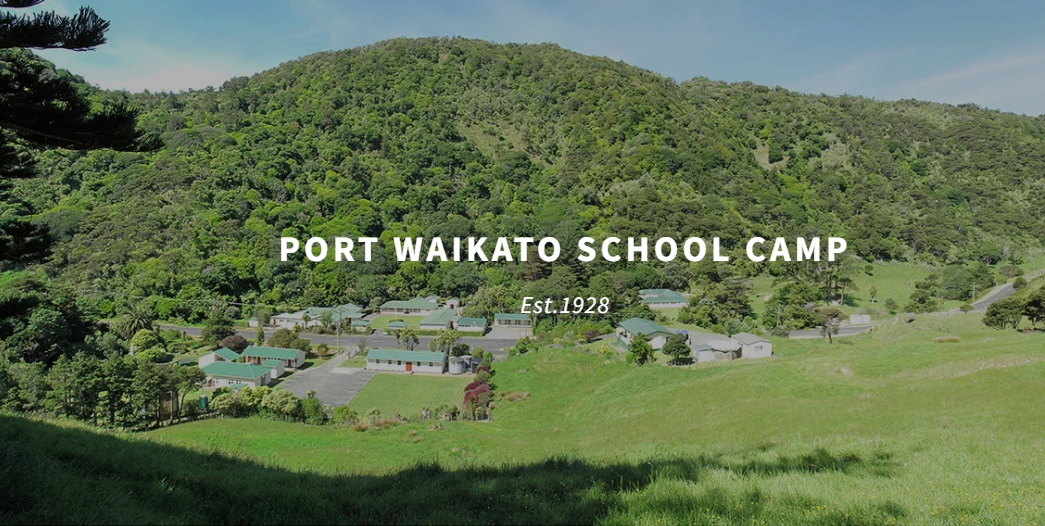

Port Waikato School Camp is a self-catered school camp at Port Waikato, where the Waikato River meets the Tasman Sea on the northern Waikato coast. Run by a volunteer trust, with camping on the site going back to 1928, it sleeps up to 140 in dormitories and smaller cabins and has a dining hall and kitchen set up for the whole group. Students can use the low ropes course, climbing wall, BMX track and archery on site, with bush tramps, orienteering, rock pools, dunes and the beach close by.
Why schools choose Port Waikato School Camp
- Room for a whole syndicate: around 100 dormitory beds plus about 32 beds in smaller rooms for teachers and parent helpers.
- Plenty of free gear: archery, a low ropes course, BMX bikes and track, petanque, volleyball, frisbee golf and more are free to use, with charges only for breakages.
- Tramps from the door: Bald Spur and Devlin’s Dash start at camp, with maps and route notes supplied.
- A natural classroom: bush, stream, estuary, dunes, beach and rock pools are all within reach for nature study.
- Your camp, your programme: self-catered and self-run, so schools set the timetable and menu, with the option of bringing in outside providers.
- Affordable: a volunteer-run, not-for-profit trust with a simple per-person nightly rate.
- Long history: generations of children have camped here since 1928.
School camp accommodation
The camp sleeps up to 140 across buildings on both sides of Port Waikato Waikaretu Road and over the stream bridge, which makes it easy to separate boys, girls and adults.
Dormitories
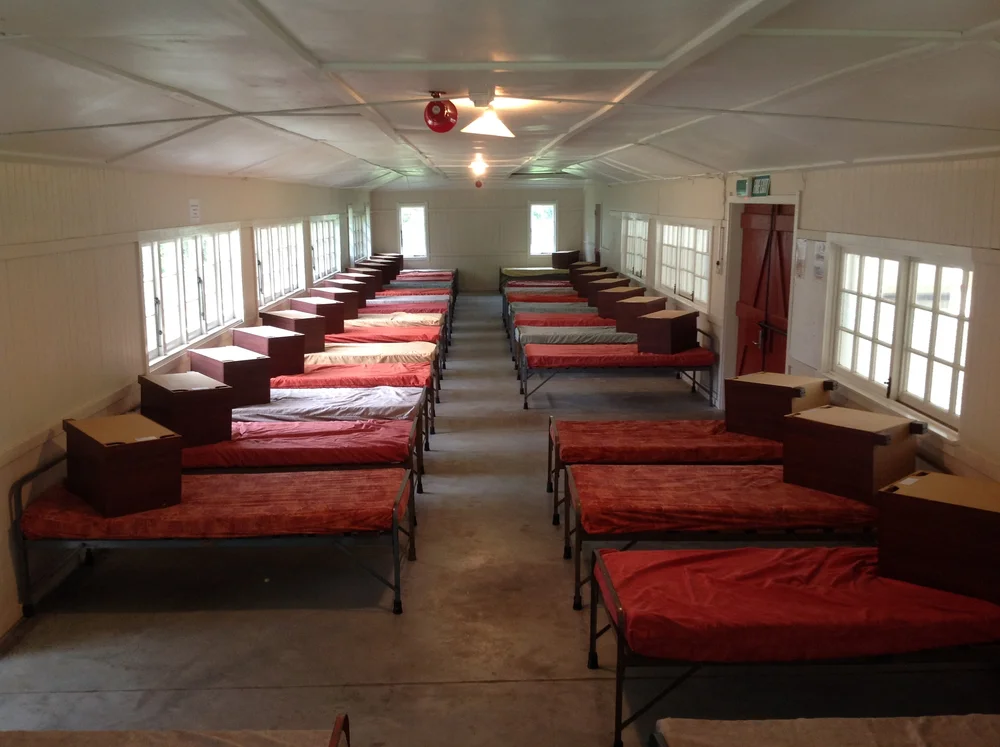
Four main dormitories with around 100 beds and foam mattresses, including the Maunsel, Spargo, Ashwell and Morgan dorms. Several dorms have an attached room for a supervising adult.
Cabins and rooms for adults
About 20 smaller rooms with roughly 32 beds in one and two-berth layouts, including the Ensor Block, Captain’s Cabin, the Honeymoon Suite, Dame Hilda Hut, the Chapel Huts and the Apartments, which have their own toilet and shower.
The Palace
A self-contained unit for school group leaders, with three beds, a small kitchen and dining area, and its own shower and toilet.
Mattresses are provided. Bring pillows and bedding, your own kitchen knives, cold-water laundry powder and pegs, and your group’s medical supplies.
Facilities for school groups
- Caesar Roose Hall: the dining hall, about 18 by 8 metres, with nine large tables with bench seats plus two half-size tables, and continuous boiling water.
- Kitchen: gas hobs, electric stoves, toasters, microwave, two fridges, two freezers, a cool room, a sterilizer, and crockery and cutlery for 140.
- Old Hall: restored, with historic photographs of the camp.
- Showers and toilets: separate girls’, boys’, staff and adult facilities, with gas-heated showers.
- Laundry and drying room, with commercial machines for adult use.
- Medical room.
- Equipment store with tents, packs and cooking gear for camping out.
- Wi-Fi around the central Square (mobile coverage is limited).
- Adventure playground, wire bridge and hard courts for free play.
Self-catering
Port Waikato School Camp is self-catered. The kitchen is equipped for 140, so parent helpers can cook for the whole camp, or schools can bring in a caterer. Bread, milk and groceries can be ordered ahead from local suppliers, and the Port Waikato store is nearby.
Activities on site
Activities are run by the visiting school. Equipment is free to use, and the camp’s booklets and safety notes help with planning.
Adventure and challenge
- Low ropes course: groups read and sign the course booklet, with adult supervision.
- Climbing wall: a 9-metre belayed wall, used only with a qualified instructor.
- Abseiling: available through outside providers who bring their own gear.
- BMX track: a 250-metre track with four bikes and helmets.
- Archery: four sets with targets and an arrow screen.
- Trampoline (supervised, two at a time).
Games and sport
- Petanque, volleyball, basketball and netball hoops, frisbee golf, cornhole, outdoor Jenga, indoor bowls and games marked on the hard courts.
Walks and tramping
- Bald Spur: a 2–3 hour climb, with a rope-assisted section, to a ridge looking over the camp and the Waikato River. On a clear day you can see Auckland’s Sky Tower.
- Devlin’s Dash: a 5–7 hour tramp, with a topographic map and written route instructions.
- Waterfall walk: about 30 minutes each way.
- Farm walks on neighbouring land, arranged with the farm manager at least four weeks ahead.
Learning outside the classroom
- Orienteering and compass work using the camp course and maps, with help available from the local orienteering club.
- Nature studies in the bush, stream, estuary, dunes, beach and rock pools.
- Geology and fossils, once the fossil site has been checked for safety.
- Māori and early European history of the area, with the camp’s own history book.
- Camping out and outdoor cooking (fire permits are needed in some months).
- Fishing.
Curriculum connections
A camp at Port Waikato fits well with education outside the classroom (EOTC) and can support learning in:
- Science: coastal, estuary and freshwater ecosystems, dune systems and fossil-bearing rocks.
- Social Sciences: the history of the Waikato River mouth and nearly a century of camping at Port Waikato.
- Health and Physical Education: tramping, navigation, challenge activities, water safety and teamwork.
- Key competencies: managing self, relating to others and participating and contributing through shared camp life, cooking and cleaning.
Outside providers
Schools can bring in outdoor education providers for instructed activities such as climbing, abseiling, caving and kayaking, or arrange surf lifesaving sessions. The camp keeps a list of providers and caterers, though the trust doesn’t endorse any particular one.
A camp with history
Children have been coming to Port Waikato to camp since 1928. Since 1989 the camp has been looked after by the Port Waikato School Camp Trust, run by unpaid volunteers, with a part-time caretaker on site. Hundreds of old slides and camp books have been digitised, and the camp’s history is recorded in its own book.
School camp rates
School groups pay a single per-person nightly rate for students, teachers and parent helpers, with a minimum charge per night. Professional outside providers are charged a separate rate. Groups clean the camp themselves before an end-of-camp inspection with the caretaker, and payment is made by direct credit after the camp. Contact the camp for current rates and availability.
Example three-day camp
An example of how a school camp at Port Waikato could look (every camp is planned by the school):
- Day 1: Arrive and meet the caretaker, settle into the dorms, fire evacuation drill, low ropes and BMX rotations, evening games in Caesar Roose Hall.
- Day 2: Tramp up Bald Spur, afternoon orienteering and archery, outdoor cooking.
- Day 3: Rock pool and estuary study, group clean-up and inspection, depart.
Getting there
The camp is on Port Waikato Waikaretu Road at Port Waikato, on the southern side of the Waikato River mouth. Tuakau and Pukekohe are the nearest towns for supplies and medical care, and the camp is within easy reach of schools across south Auckland and northern Waikato.
Nearby attractions for school groups
- Sunset Beach: the Port Waikato surf beach, patrolled by surf lifeguards in summer. Swim between the flags, as rips can be strong.
- Port Waikato sand dunes: big black-sand dunes beside the river, great for climbing and rolling down.
- Waikato River mouth and Maraetai Bay: riverside spots for crabbing, pipi digging and watching whitebaiters in season.
- Coastal cliffs and rocks: sedimentary rock formations with fossils, ideal for geology studies.
- Nikau Cave: guided cave tours about 28 km away, booked and paid separately.
Other groups and events
- Guiding, youth and church groups: affordable group accommodation with a big hall and kitchen.
- Family reunions and gatherings: weekend hire with plenty of beds.
- Weddings: Caesar Roose Hall and the grounds can be hired for a Friday to Sunday wedding weekend, with marquees allowed by arrangement.
- Social functions: weekend hire from Friday afternoon to Sunday afternoon.
Good to know
- Arrival is from midday and departure by midday, unless arranged otherwise with the caretaker.
- Contact the caretaker at least 24 hours before arrival, and meet them within an hour of arriving.
- The group leader acts as fire warden, and a trial evacuation is held on the first day.
- Groups do their own cleaning and remove their rubbish.
- Mobile coverage is limited, but Wi-Fi is available around the Square.
- No dogs except guide dogs, and all buildings are smoke-free.
Frequently asked questions
How many students can Port Waikato School Camp accommodate?
Up to 140, with around 100 dormitory beds and about 32 beds in smaller rooms for adults.
Is the camp catered?
No. It is self-catered, with a kitchen and dining hall set up for 140. Schools can bring in a caterer if they prefer.
What activities are on site?
A low ropes course, 9-metre climbing wall, BMX track, archery, trampoline, petanque, volleyball, frisbee golf, orienteering and bush walks, with free use of the equipment.
Are instructors provided?
No. Schools run their own programme, and the climbing wall needs a qualified instructor. Outside providers can be brought in.
What do we need to bring?
Pillows and bedding, kitchen knives, cold-water laundry powder and pegs, and your own medical supplies. Mattresses are provided.
Who runs the camp?
The Port Waikato School Camp Trust, run by volunteers since 1989, with a part-time caretaker on site.
Where is Port Waikato School Camp?
It is on Port Waikato Waikaretu Road at Port Waikato, at the mouth of the Waikato River on the northern Waikato coast.


1 Review on “Port Waikato School Camp”
We’ve used this campsite for a number of Brownie camps over the past 10yrs. The facilities are great, accommodation fits all our girls and leaders and it’s close to the beach for a walk.