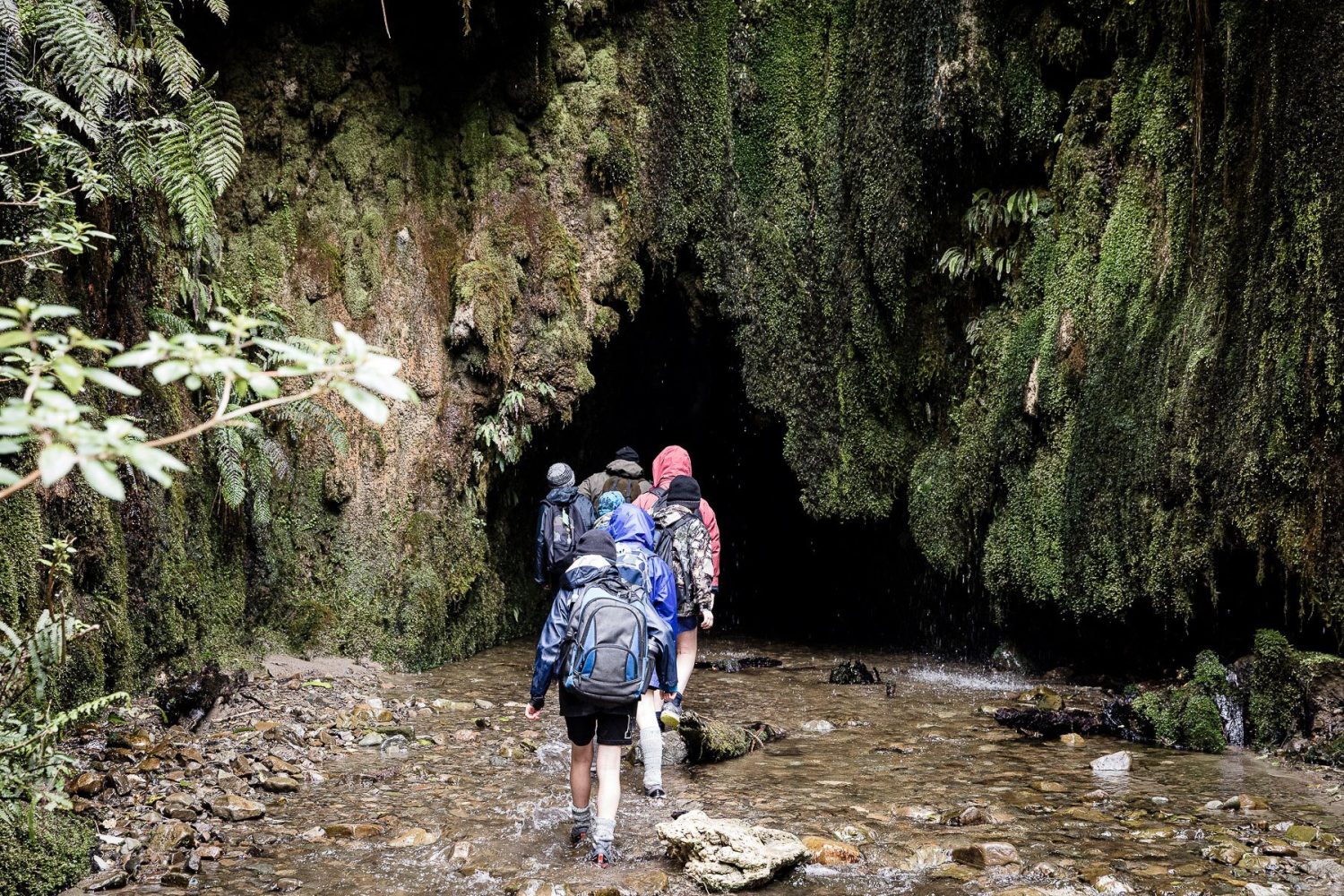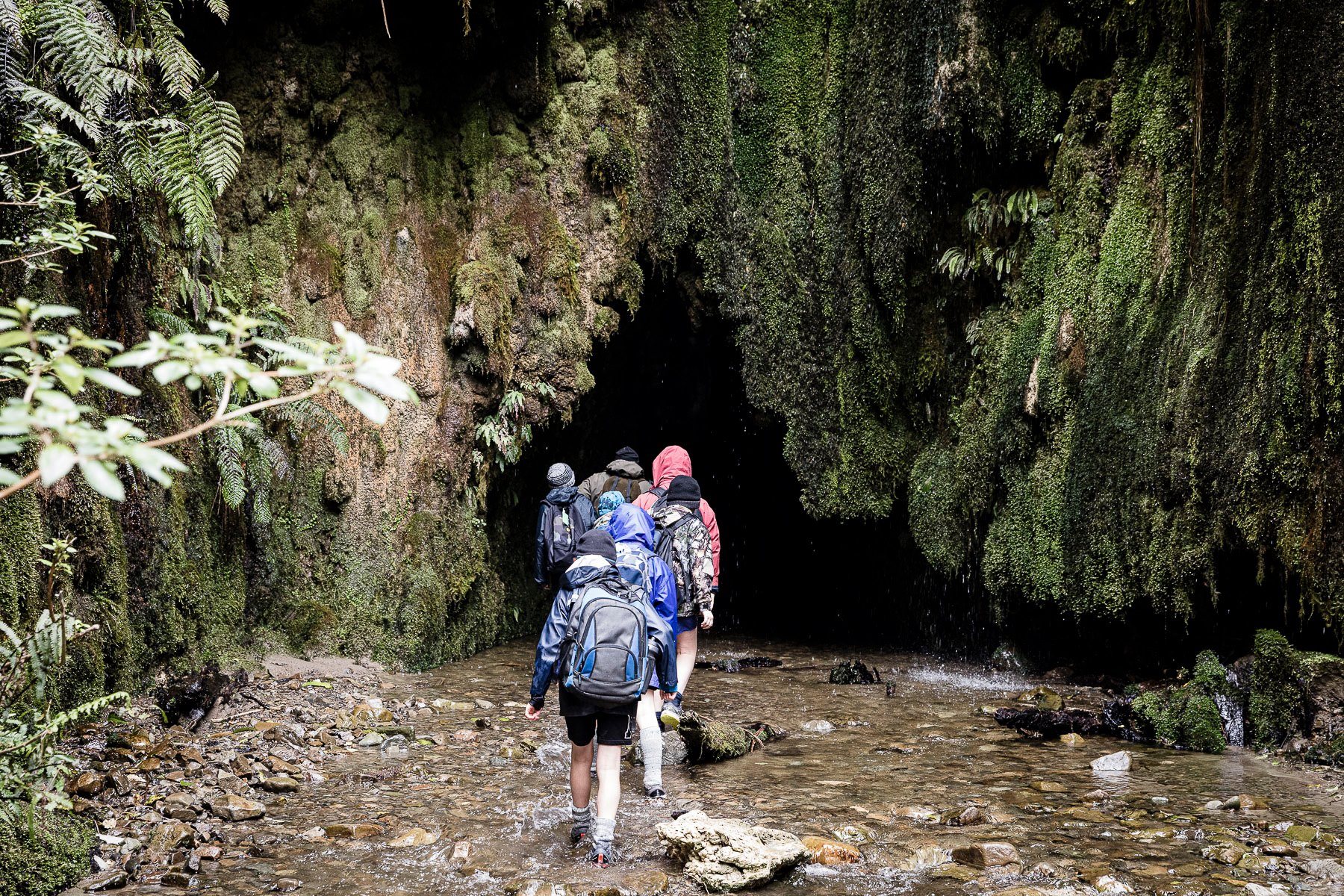
Sixtus Lodge is a self-catering outdoor education centre on Limestone Road near Āpiti, in the Manawatū foothills of the Ruahine Ranges. Built in 1977 by local intermediate schools on land gifted by farmer Les Sixtus, it has been a Manawatū school camp for almost 50 years, with sole use of a six-hectare property where farmland meets native bush, a short walk from glow-worm caves and the edge of Ruahine Forest Park. Two buildings sleep up to 51 people, and a volunteer trust keeps it affordable for schools and community groups.
Why schools choose Sixtus Lodge
- Your group has the whole property to itself for the length of the booking
- Room for up to 51 across the Main Lodge and Toka Cottage, with a separate cottage that suits supervising adults
- Glow-worms close by, both in the Limestone Creek Reserve caves and along Cone Creek
- Bush walks, a native tree arboretum and a creek within the grounds, with Ruahine Forest Park tracks starting about 1 km up the road
- A Challenge Course on the lawn for team-building and problem-solving games
- Students and the adults who come with school groups pay the same low nightly rate
- Schools can check in at 10am, so the first day isn’t lost to travel
School camp accommodation
A booking gives your group sole occupancy of Sixtus Lodge. The two buildings together take up to 51 guests, and both are self-contained.
Main Lodge
The Main Lodge sleeps 47 in bunk beds with vinyl mattresses, spread over two large and two small bunkrooms on either side of the central lounge and dining room. Bathrooms and toilets open off the sleeping areas. The lounge has movable furniture so you can set it up for meals, briefings or games, and it’s heated by a wood-burner with firewood supplied.
Toka Cottage
Toka Cottage sits beside the Main Lodge and has four single beds, its own kitchen, electric heating and fully accessible bathrooms. It works well as a base for teachers and parent helpers, but it isn’t set up for children without adults.
Tent sites, caravans and campervans
The Lodge fields and a picnic area near the bridge, about 200 m past the Lodge, can be used for tents, with a long-drop toilet nearby. Registered, self-contained caravans and campervans are also welcome for a nightly charge, though there are no external power outlets for vehicles.
Bring all bedding, pillows and towels (mattress toppers or fitted single sheets are recommended for the vinyl mattresses), plus tea towels, cleaning products, toilet paper, rubbish bags and a first aid kit for your group.
Facilities for school groups
- Large lounge and dining area with reconfigurable furniture, a wall-mounted TV with HDMI cable and a wood-burner
- Well-stocked kitchen with plenty of pantry storage, large fridge and freezer, microwaves, toaster ovens, electric frypans and a continuous hot water unit
- Laundry with washing machines, and a heated drying room for wet gear
- Ngamoko Room, a carpeted all-purpose teaching space with benches, water and a table tennis table
- Concrete pad and wall behind the Ngamoko Room with a basketball hoop
- Large mown field with volleyball poles and net
- Challenge Course at the east end of the grounds
- Gas barbecue (bring your own gas bottle) and a large wood-fired barbecue
- Margot Forde Arboretum of native trees, with a signposted loop track
- Bush reserve with walking tracks down to Cone Creek
- Free Wi-Fi
- Spring-fed water supply, UV treated and regularly tested
- Security cameras covering the outside of the buildings and the car park
Catering
Sixtus Lodge is fully self-catering. Groups bring all their own food and drink, including tea, coffee and milk, and cook in the Main Lodge kitchen, which is stocked with pots, pans, utensils, crockery and cutlery for large numbers. Toka Cottage has a separate kitchen for adults who prefer to cater for themselves.
Learning opportunities
There are no instructors on site, so teachers plan and run their own programme. The Trust Board’s free guidebook, The ABC of Sixtus Lodge, is full of ideas for using the property and the surrounding bush, and copies are kept at the Lodge. A stay at Sixtus Lodge can support:
- Science (living world), through native trees in the arboretum, upland forest that shows the marks of past logging, insects, lizards, ferns, mosses, lichens and alpine plants
- Bird study, with korimako (bellbird), pīwakawaka (fantail), riroriro (grey warbler), miromiro (tomtit), kererū, tūī, ruru (morepork) and kāhu (harrier) all likely around the Lodge
- Stream studies in Cone Creek and Coal (Makiekie) Creek
- Earth and space science, through the limestone landscape, red argillite rock formations and clear, dark night skies for stargazing
- Social sciences, through the history of Sixtus Lodge, the Āpiti district and how the land has been farmed and logged
- The arts, with the Ngamoko Room set up for art and craft such as bark rubbings and work with harakeke (flax)
- Health and physical education, through tramping, outdoor safety and the Challenge Course
- Education outside the classroom (EOTC) and key competencies such as managing self, relating to others, and participating and contributing
Teachers’ Orientation Course
Teachers leading a school camp at Sixtus Lodge are asked to complete the Trust Board’s Teachers’ Orientation Course, which introduces the Lodge and the walks best suited to students. Check with the Trust Board for the next course date.
Activities on site
Team challenges and games
- Challenge Course, built years ago by the Palmerston North Lions, with seven structures used for co-operation and problem-solving activities (a guidebook is kept at the Lodge and some activities need adult supervision)
- Rope trail challenges, including blindfold, paired and night-time versions
- Orienteering on the Lodge terrace and formed tracks
- Volleyball, basketball, table tennis and field games (bring your own balls and bats)
Bush, streams and the arboretum
- Short tracks from the grounds down through native bush to Cone Creek, including the path through The Dell
- Loop track through the Margot Forde Arboretum, where the native trees are being replanted and newly signed
- Stream exploration in Cone Creek, with shallow pools for paddling
- Grassland digging studies in the paddock behind the arboretum
After dark
- Glow-worm spotting along Cone Creek or at the Limestone Creek Reserve caves
- Stargazing, from finding the Southern Cross to telling planets from stars and spotting satellites
- Campfires in the fireplaces and pits provided (check fire restrictions first)
Local walks and tramps
Sixtus Lodge sits close to two Ruahine Forest Park road ends, Limestone Road and Petersons Road, so there’s a wide range of walking from the door. The Trust Board publishes detailed notes on each route, and large maps of the Western Ruahine Ranges are displayed at the Lodge.
- Deerford Track – a gentle, well-formed track that stays under bush cover, suitable in most weather and for all ages
- Deerford, Diagonal and Shorts’ loop – a 4–5 hour round trip that stays below the bushline and suits primary-aged students who are ready for a challenge
- Coal (Makiekie) Creek – about 10 minutes from the Limestone Road car park along a poled route
- Red Rock – red argillite outcrops upstream on Makiekie Creek, around 2–3 hours return from the Lodge
- Oroua River and Alice Nash Memorial Heritage Lodge – a downhill walk of about an hour from Petersons Road to the river, past the Arch Bridge and the NZ Deerstalkers’ Association’s Heritage Lodge, with a longer climb back
- Iron Gates Gorge – a 4–5 hour summer route along the Oroua River to a narrow rock gorge, only when the river is low and clear
- Knight’s and Shorts’ Tracks – full-day climbs to the crest of the Ngamoko Range and Toka Trig (1526 m), for older, fit and well-led groups
Leaders should check the weather and track conditions before heading out, and the Trust Board advises that at least one leader has walked a route before taking young people above the bushline.
The Sixtus Lodge story
In the mid-1970s, Palmerston North intermediate schools were struggling to find a nearby camp, as the only suitable venue in the region was booked out and fuel costs were rising. Parents from Palmerston North Intermediate Normal School went looking for a site in the Ruahine foothills, and local farmer Les Sixtus offered land at no cost, sharing their wish for town children to experience bush and mountain life. A committee of parents and teachers from several schools raised the funds and planned the building, which went up in 1977 with volunteers doing the finishing work. The first class arrived in October 1977, and the Minister of Education opened the Lodge that December.
Today Sixtus Lodge is run by the Sixtus Lodge Trust Board, a registered charity whose volunteer members look after the property through regular meetings and working bees. Several board members have family links to the original founding committee, and Lorraine Sixtus is the trust’s patron.
School camp rates
Rates are charged per person per night, and school groups get a reduced rate for students and accompanying adults alike. There’s a minimum nightly charge for every group. A non-refundable deposit secures your dates and can be moved to new dates if plans change, with the balance due within a week of your stay. Invoices are available on request. Contact the Booking Secretary for current rates.
Example three-day camp
This is an example only. Teachers plan their own programme at Sixtus Lodge, and the Trust Board can suggest walks that suit your group.
Day 1
- Arrive from 10am and settle into the bunkrooms
- Challenge Course activities to get the group working together
- Explore the arboretum loop and the bush tracks down to Cone Creek
- Evening: glow-worm walk to Cone Creek bridge
Day 2
- Deerford, Diagonal and Shorts’ loop with a packed lunch at the high point
- Evening: stargazing and campfire (fire restrictions permitting)
Day 3
- Morning visit to the Limestone Creek Reserve glow-worm caves
- Stream study in Cone Creek or art in the Ngamoko Room
- Clean up, complete the tenants’ checklist and depart by 2pm
Getting there
Sixtus Lodge is about 80 km north of Palmerston North. From Āpiti, take Table Flat Road, which becomes Limestone Road, and continue to the Lodge. The last stretch is narrow, winding and unsealed, so allow extra time for buses, drive with care and watch for stock and horses. Fill up before you leave, as the nearest fuel is at Kimbolton and is card-only.
Nearby attractions for school groups
- Limestone Creek Reserve glow-worm caves – a limestone gorge and cave about 1 km from the Lodge, protected by a QEII National Trust covenant on private land, with a short loop track. Bring torches for a night visit.
- Ruahine Forest Park – DOC conservation land with tracks starting at the Limestone Road and Petersons Road ends
- Oroua River and the Iron Gates Gorge – the largest river nearby, reached from Petersons Road
- Āpiti Scenic Reserve – a popular Oroua River swimming spot
- Table Flat horse treks – horse trekking based across the road from the Lodge
- Cross Hills Gardens, Kimbolton – about 7 hectares of rhododendrons, azaleas and specimen trees, at their best in October and November
- Kimbolton – a small township on the way, with a café, fuel and Heritage Park
Other groups and events
Sixtus Lodge welcomes all groups, not just schools. It suits:
- Scouts, youth and church groups
- Tramping, hunting and outdoor clubs using the Ruahine Forest Park
- Conservation and volunteer projects
- Team-building weekends
- Family gatherings and groups of friends wanting a quiet break
The Lodge is set aside for Trust Board members over the Christmas holidays, roughly mid-December to early January, but other group bookings in that period may be possible.
Good to know
- Check-in is 10am for schools and 3pm for other groups, and everyone checks out by 2pm. Times can sometimes be changed by arrangement.
- The door code and Wi-Fi password are sent to the camp organiser shortly before the camp
- School groups need a ratio of at least one adult to six students, with constant supervision
- Groups clean the Lodge during and at the end of their stay, and complete an online tenants’ checklist when they leave
- There’s no rubbish collection, so all rubbish, recycling and food scraps go home with you
- No dogs or other pets, no fireworks, and no smoking or vaping
- There’s no landline. Mobile coverage is reasonable, and generally better outside than in the buildings.
- The Lodge is bordered by working farmland, so keep gates shut, cross fences only at stiles and stay off neighbouring land
- Mountain weather changes quickly, so pack warm, waterproof layers and sturdy footwear
Frequently asked questions
How many people can stay at Sixtus Lodge?
Up to 51 people: 47 in the Main Lodge bunkrooms and four in Toka Cottage.
Where is Sixtus Lodge?
It is on Limestone Road near Āpiti in the Manawatū, in the foothills of the Ruahine Ranges and about 80 km north of Palmerston North.
Is Sixtus Lodge catered?
No. It is fully self-catering, with a well-equipped kitchen in the Main Lodge and a second kitchen in Toka Cottage.
Are there instructors or activities provided?
There are no instructors on site. Teachers run their own programme using the Challenge Course, bush tracks, arboretum, creeks and nearby Ruahine Forest Park walks.
Are there glow-worms near Sixtus Lodge?
Yes. The Limestone Creek Reserve glow-worm caves are about 1 km away, and glow-worms can also be seen along Cone Creek at night.
What do we need to bring?
All food, bedding, pillows and towels, cleaning products, toilet paper, rubbish bags and first aid supplies.
Do we get the whole Lodge to ourselves?
Yes. Every booking gives sole occupancy of the property.
Can other groups book Sixtus Lodge?
Yes. All groups are welcome, including youth groups, clubs, families and team-building groups.