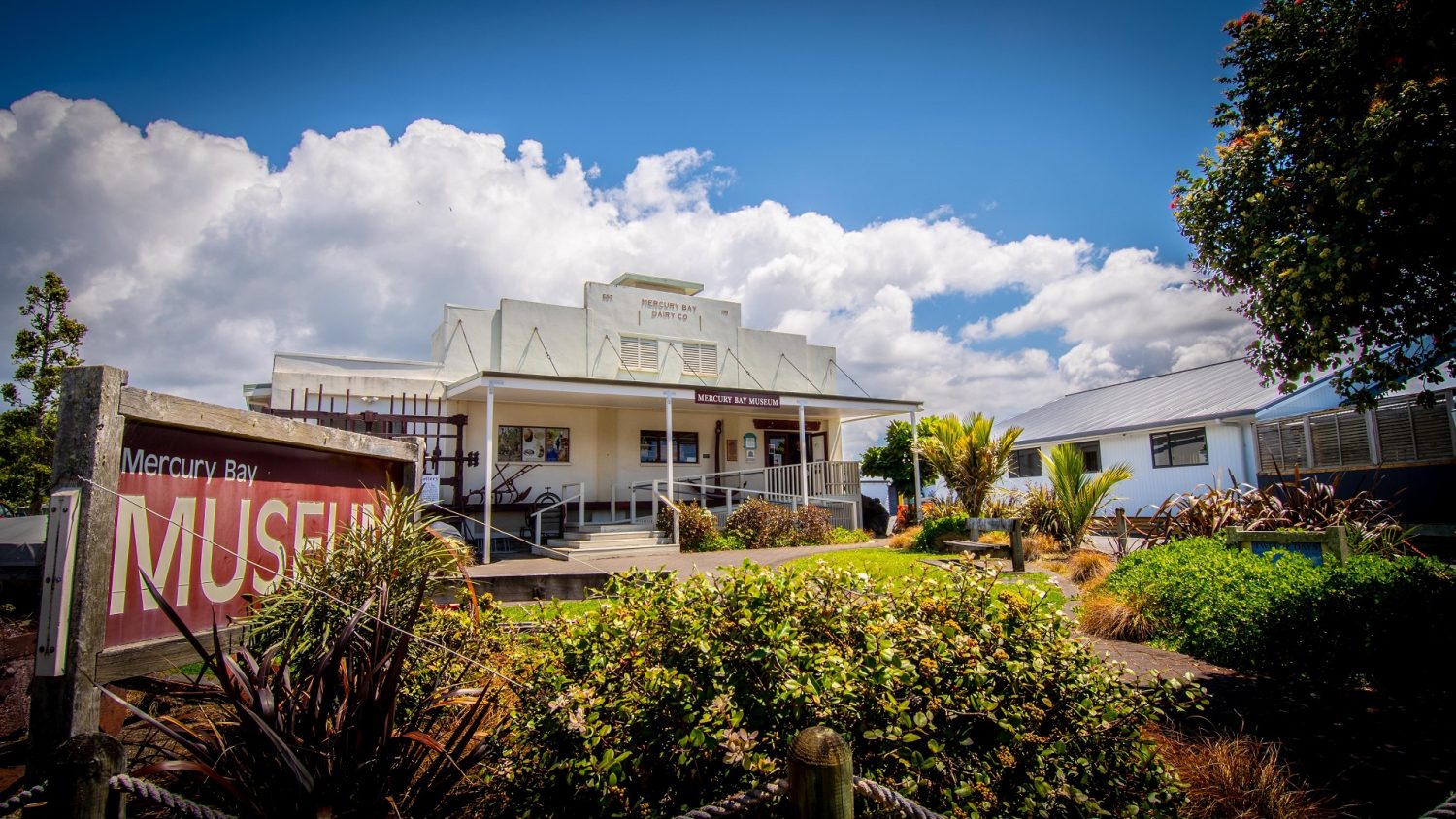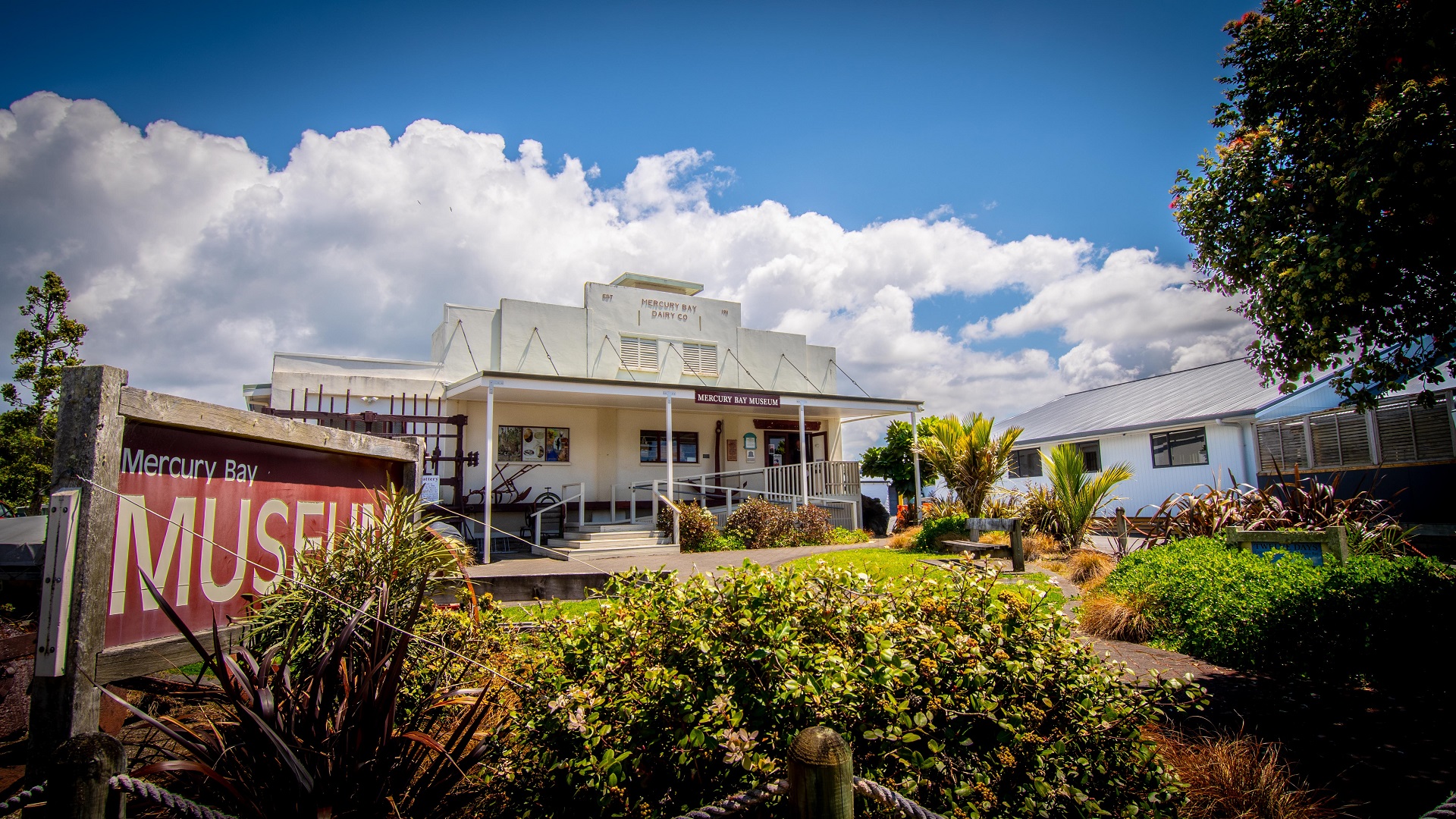
Mercury Bay Museum sits on the waterfront in Whitianga, opposite the wharf, on the Coromandel Peninsula. Housed in the town’s former dairy factory, it tells the stories of Te Whanganui o Hei | Mercury Bay, from Kupe and Māori taonga to Cook’s 1769 visit aboard the Endeavour and the 1840 wreck of HMS Buffalo. For a Whitianga school trip or a Coromandel school camp activity, the museum runs education programmes for Years 1–10, can tailor sessions for Years 11–13 and early childhood groups, and can also bring a box of taonga out to your classroom.
Why schools choose Mercury Bay Museum
- Local stories, close up: exhibits on Kupe, Māori taonga, Cook and the Endeavour, kauri and gum, dairying and early settler life.
- A shipwreck on the doorstep: the HMS Buffalo wreck lies about 50 m off Buffalo Beach, and the museum leads a maritime archaeology project on it.
- Programmes for most year levels: Years 1–10 as standard, with tailored options for Years 11–13 and early childhood.
- A range of learning styles: storytelling, object handling, educator-led sessions, outdoor learning, hands-on making and virtual reality.
- Museum in a Box: staff can bring a tailored box of taonga to your school or centre.
- Central and accessible: on The Esplanade in Whitianga, with wheelchair access and parking.
- Natural history too: displays on local natural history and the Hauraki Gulf, including a colossal squid exhibit.
School programmes and activities
Programmes are planned with the museum to suit each group. The museum describes several approaches it can draw on:
Shared learning sessions
Whole-class sessions built around visual storytelling and guided discussion.
Object-based learning
Students work with objects, replicas and related activities to explore local stories.
Facilitated classroom learning
Sessions led by a museum educator and adjusted for different ages and learning needs.
Outdoor and place-based learning
Local history explored outside, through discussion and shared activities.
Technology-enhanced exploration
Digital tools, including virtual reality, used to explore the collection and its stories.
Hands-on discovery
Practical activities based on making, doing and problem-solving.
Museum in a Box
Museum staff visit your classroom or education centre with a box of taonga chosen to suit your topic. One programme delivered this way, Little Ship – Big Minds, has looked at HMB Endeavour and some of the people on board during the 1769 visit to Mercury Bay, using an image board and props so children can dress up as Captain Cook.
Exhibitions
Galleries cover themes including Shaping Te Whanganui o Hei, Taonga, HMS Buffalo, The Kauri, The Dairy Factory, The Blacksmith, Whiti Town 1943 and In Our Backyard, alongside changing exhibitions such as The Living Gulf and A Bach Life.
Session lengths and group sizes are agreed at booking.
Learning opportunities
The collection links the history of one bay to bigger national stories: Polynesian voyaging, first encounters between Māori and Europeans, early shipping and immigration, and the industries that shaped the Coromandel.
Curriculum connections
A visit to Mercury Bay Museum can support education outside the classroom (EOTC) and learning in:
- Social Sciences: Aotearoa New Zealand’s histories, including Kupe, Cook’s 1769 visit, the HMS Buffalo and local settlement.
- Science: natural history, marine life in the Hauraki Gulf and the colossal squid.
- Technology: maritime archaeology methods, blacksmithing and dairy factory processes.
- English: storytelling, research and writing from primary sources and objects.
- Key competencies: thinking, using language, symbols and texts, and relating to others through group discussion and hands-on tasks.
Safety and instruction
Facilitated sessions are led by museum educators. The museum’s education booking form sets these adult to student ratios:
- Pre-school: 1 adult to 4 children.
- Years 0–6: 1 adult to 6 students.
- Years 7–10: 1 adult to 10 students.
- Years 11–13: 1 adult to 25 students.
The booking form also asks schools to note any special needs in the group.
Adding Mercury Bay Museum to a school camp
For schools camping in Whitianga or the wider Mercury Bay area, the museum is an easy half-day or shorter session in town, and it gives context to the places students may visit later in the camp, such as Buffalo Beach, Ferry Landing and Cooks Beach. It pairs well with beach, marine reserve and walking days, and the indoor setting makes it a useful option when the weather turns.
About Mercury Bay Museum
The museum grew out of a community effort led by the Whitianga Lions Club, which began collecting artefacts around 1969. With local fundraising and support from benefactors, the former Thames Te Aroha Dairy Company factory on The Esplanade was bought, and the museum was officially opened on 07/12/1979. Its stated purpose is to protect, share and preserve the culture and heritage of Te Whanganui o Hei | Mercury Bay. The museum also runs a research centre with cemetery records, family archives and photo archives.
School group rates
Children under 14 visit free with an accompanying adult, and students aged 15–18 pay a reduced student rate for general admission. Groups of 10 or more are asked to contact the museum. Education programmes are charged per student and per adult, with some accompanying adults free. Contact Mercury Bay Museum for current rates.
Example school visit
An example of how a school visit to Mercury Bay Museum could look (every visit is planned with the provider):
- Arrival: welcome and introduction to Te Whanganui o Hei and the museum.
- Shared learning session: storytelling and discussion on Kupe and Cook’s 1769 visit.
- Object-based learning: small groups work with objects and replicas from the collection.
- Gallery time: students explore the HMS Buffalo, kauri and dairy factory displays.
- Afterwards (school-led): walk along The Esplanade to Buffalo Beach, where the HMS Buffalo was wrecked.
Getting there
The museum is on The Esplanade in central Whitianga, opposite the wharf, with parking and wheelchair access on The Esplanade. Whitianga is on the eastern side of the Coromandel Peninsula, roughly an hour and a quarter from Thames and around two and a half hours from Auckland by road.
Nearby attractions for school groups
- Buffalo Beach: Whitianga’s main beach, named after HMS Buffalo, whose wreck lies just offshore.
- Whitianga passenger ferry: a short harbour crossing from the wharf to Ferry Landing.
- Whitianga Rock: a historic pā site and scenic reserve near Ferry Landing.
- Shakespeare Cliff: a lookout over Mercury Bay above Lonely Bay and Cooks Beach.
- Cooks Beach: near the area where Cook landed and observed the transit of Mercury in 1769.
- Te Whanganui-A-Hei (Cathedral Cove) Marine Reserve: a marine reserve near Hahei for marine science.
- Hot Water Beach: geothermal springs that rise through the sand around low tide.
Other groups and events
The museum runs family events and workshops through the year, a Museum Explorers passport club for children, early childhood visits and a family history research service. It is open to the general public Monday to Saturday.
Good to know
- Bookings: contact the museum to plan a programme, then complete the education booking form.
- Opening days: Monday to Saturday, closed on Christmas Day, Boxing Day, Good Friday, Easter Sunday and Anzac Day.
- Year levels: Years 1–10 as standard, Years 11–13 and early childhood by arrangement.
- Supervision: schools need to bring enough adults to meet the museum’s ratios.
- Accessibility: wheelchair access is available.
- Weather: the museum is indoors, so visits can go ahead in most weather.
Frequently asked questions
What year levels does Mercury Bay Museum cater for?
Programmes are designed for Years 1–10, and the museum can tailor sessions for Years 11–13 and early childhood groups.
Can the museum come to our school?
Yes. Through Museum in a Box, staff bring a tailored box of taonga to your classroom or education centre.
What topics can a school visit cover?
Topics include Kupe and Māori taonga, Cook’s 1769 visit, the HMS Buffalo wreck, kauri and gum, dairying, early settler life and local natural history.
How many adults do we need to bring?
The booking form sets 1 adult to 6 students for Years 0–6, 1 to 10 for Years 7–10 and 1 to 25 for Years 11–13.
How are school visits charged?
Education programmes are charged per student and per adult, with some adults free. Contact the museum for current rates.
Is the museum wheelchair accessible?
Yes, there is wheelchair access and parking on The Esplanade.
When is the museum open?
Monday to Saturday, closed on Christmas Day, Boxing Day, Good Friday, Easter Sunday and Anzac Day.
How do we book?
Contact the museum to discuss your programme, then complete its education booking form.