
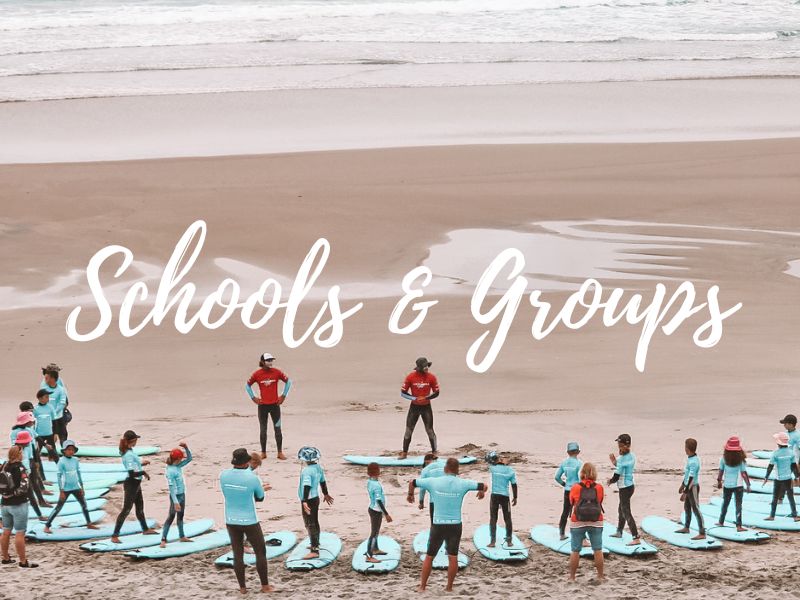

Aotearoa Surf School – Auckland runs surfing, stand up paddleboarding and beach education days for primary, intermediate and secondary schools at Orewa Beach, Long Bay and other beaches and lakes around Auckland. It is a practical option for an Auckland school trip or a Hibiscus Coast school camp activity, with every board, wetsuit and instructor supplied, groups rotating between water and beach stations, and programmes shaped to the age of the class. Half-day programmes take from 4 to 60 students, and full days up to 100.
Why schools choose Aotearoa Surf
- Built for first-timers: lessons start on the sand and progress at each student’s pace, with standing-depth water for non-swimmers.
- Whole classes or year levels: groups rotate through two or three stations so in-water numbers stay small while the rest of the group stays busy.
- Everything supplied: wetsuits in all sizes, soft learner boards, rash shirts, sunscreen and the gear for water and land activities.
- Tight in-water ratios: one instructor to four to eight students, tightened further for juniors and non-swimmers.
- Paperwork done for you: activity-specific RAMS, a Proposal Agreement, consent templates and an itinerary are supplied, which keeps the EOTC workload for staff low.
- A learner-friendly home beach: Orewa has a long, gently sloping sandy bank, small consistent whitewater, bus drop-off, parking and toilets close to the sand.
- Room to grow: day trips can lead into multi-day programmes or a fully hosted overnight camp at Mangawhai.
School programmes and activities
Half-day surf programme
A core surf lesson combined with beach safety, for groups of 4 to 60 students. It suits a first taste of surfing or a single class outing.
Full-day multi-activity programme
For groups of around 30 to 100 students, combining surfing with a rotation of other activities. Depending on the group, the location and the conditions, stations can include:
- Surfing for all ability levels
- Stand up paddleboarding and kayaking
- Snorkelling and coastal exploration
- Surf rescue and beach education, including spotting rips
- Beach games, sports and confidence-building challenges
- Team building and leadership activities
Progressive and term programmes
Aotearoa Surf also runs progressive surf programmes over one to five days for Years 3 to 13, as day programmes, electives or part of a camp, with skills built in stages and clear achievement markers. Weekly sessions across a term are available for PE classes and senior programmes. Progressive programmes for senior students can include NCEA Level 2 and 3 credits.
Year levels
Programmes are tailored for primary (Years 1 to 6), intermediate (Years 7 to 8) and secondary (Years 9 to 13) students, and sports teams and PE classes are welcome.
Learning opportunities
The programmes are designed to build confidence, teamwork, resilience and a connection to the coast through hands-on learning outside the classroom. Learning outcomes for each session are mapped to the Health and Physical Education curriculum and Water Skills for Life.
Curriculum connections
A day with Aotearoa Surf fits well with education outside the classroom (EOTC) and can support learning in:
- Health and Physical Education: movement skills, challenge and risk management, outdoor education and hauora.
- Water Skills for Life: safe entry and exit, orientation and propulsion, identifying rips, surf-zone competence and rescue awareness.
- Science: waves, tides and the coastal environment, explored through snorkelling and coastal exploration.
- Key competencies: managing self, relating to others and participating and contributing through team challenges and leadership activities.
Safety and instruction
Instructors are ISA (International Surfing Association) qualified, first aid trained and hold surf lifesaving awards, and all staff working with schools are Police vetted. Aotearoa Surf has been teaching surfing in New Zealand since 2002 and is Qualmark Gold certified, a Surfing New Zealand recognised surf and paddleboard school, and Water Safety New Zealand accredited.
- In-water ratios of one instructor to four to eight students, depending on age, confidence and ability.
- Instructors check the beach before each session and set a supervised surf zone away from rips and other hazards, rechecking conditions through the day.
- Instructors supervise all activities in and out of the water, while teachers and adult helpers look after pastoral care.
- First aid kits are on the beach at every session, with emergency procedures for each location.
- Schools receive dated RAMS, a hazard register, emergency procedures, a qualifications matrix and Police vetting confirmation before the trip.
What to bring
Students need togs, a towel, lunch and warm clothes for afterwards. Wetsuits, boards, rash shirts, sunscreen and all other gear are provided.
Adding Aotearoa Surf to a school camp
Schools staying at a camp north of Auckland can add a surf or beach day to their programme, and Aotearoa Surf can also bring activities to a school’s own camp venue, charged per student per activity. Some Auckland schools combine an Orewa taster day early in the year with an overnight camp later on.
For a fully hosted stay, the separate Aotearoa Surf Camp – Mangawhai listing covers their overnight school camps for up to 120 students, with accommodation, all meals, transport, supervised evening and night activities and the full activity programme included.
About Aotearoa Surf
Aotearoa Surf is owned by head coach Che Burnett and has been teaching surfing since the early 2000s. Its main base is at Te Arai, and it runs programmes at Orewa, Long Bay, Omaha, Te Arai and Mangawhai, along with other Auckland and Northland coastal locations and, for some groups, Canterbury beaches. Alongside school programmes it runs after-school and holiday surf programmes, and its overnight school camps include purpose-built accommodation and facilities.
School group rates
Half-day and full-day school programmes are charged per student, and funded subsidies may be available for full-day programmes. Activities delivered at a school’s own camp are charged per student per activity. Overnight camps at Mangawhai have a per-student rate with a separate supervisor rate. Contact Aotearoa Surf for current rates.
Example school visit
An example of how a school visit to Aotearoa Surf could look (every visit is planned with the provider):
Example day
- Morning: arrive at Orewa Beach by bus, change into wetsuits and get a beach safety briefing, including how to spot a rip.
- Late morning: first rotation, with one group surfing while others paddleboard or play beach games.
- Lunch: students eat their own packed lunch on the beach.
- Afternoon: groups swap stations, with surf rescue and team challenges for those out of the water.
- Mid-afternoon: warm clothes on, debrief and back on the bus.
Getting there
Orewa Beach is on the Hibiscus Coast, around 40 minutes north of central Auckland by the Northern Motorway, with bus drop-off at the beach. Programmes can also run at Long Bay on the North Shore or at another Auckland beach or lake close to the school. Te Arai and Mangawhai are about 90 minutes north of the Harbour Bridge.
Nearby attractions for school groups
- Wenderholm Regional Park: beach, estuary and coastal forest walks just north of Orewa.
- Shakespear Regional Park: a predator-fenced open sanctuary at the tip of the Whangaparāoa Peninsula.
- Tiritiri Mātangi Island: a pest-free island bird sanctuary reached by ferry from Gulf Harbour.
- Long Bay Regional Park: a sheltered beach, playing space and coastal walks on the North Shore.
- Te Ara Tahuna (Orewa Estuary Path): a flat walking and cycling loop around the Orewa estuary.
- Goat Island Marine Reserve: New Zealand’s first marine reserve, near Leigh, well known for school snorkelling trips.
- Tāwharanui Regional Park: an open sanctuary with beaches and a marine reserve on the Tāwharanui Peninsula.
Other groups and events
Aotearoa Surf also works with youth trusts, holiday and community groups, churches, iwi and whānau groups, and runs small group surf camps for 6 to 40 people as well as after-school and holiday programmes for children.
Good to know
- No surfing experience is needed, and non-swimmers stay in standing-depth water with high-buoyancy boards and a tighter ratio.
- Rain alone doesn’t cancel a day. If surf or wind is unsafe, a decision is made the afternoon before to move to a sheltered beach, switch to a beach-based programme, or reschedule at no cost.
- Terms 1 and 4 are the busiest and fill first, while Term 2 often has better availability, so booking early is recommended.
- The split of supervision between instructors and school staff is set out in the RAMS and Proposal Agreement.
Frequently asked questions
Do students need to have surfed before?
No. Programmes are designed for beginners, starting on the sand and moving at each student’s pace.
Where do Auckland school surf days take place?
Mostly at Orewa Beach, with Long Bay and other Auckland beaches or lakes available depending on the school’s location and the programme.
What activities are included besides surfing?
Full-day programmes can include stand up paddleboarding, kayaking, snorkelling, surf rescue, beach games and team-building challenges.
How many students can come on one day?
Half-day programmes suit 4 to 60 students and full days up to 100, with groups rotating between stations to keep in-water numbers small.
What are the instructor ratios?
In the water, one instructor works with four to eight students, with tighter ratios for juniors and non-swimmers.
What happens if the weather is bad?
Rain alone doesn’t cancel a session. If conditions are unsafe, the day moves to a sheltered beach, becomes a beach-based programme, or is rescheduled at no cost.
What should students bring?
Togs, a towel, lunch and warm clothes. All surf gear, wetsuits and sunscreen are provided.
Can Aotearoa Surf host an overnight camp?
Yes. Fully hosted overnight camps for up to 120 students run at Mangawhai and are covered in the separate Aotearoa Surf Camp – Mangawhai listing.


