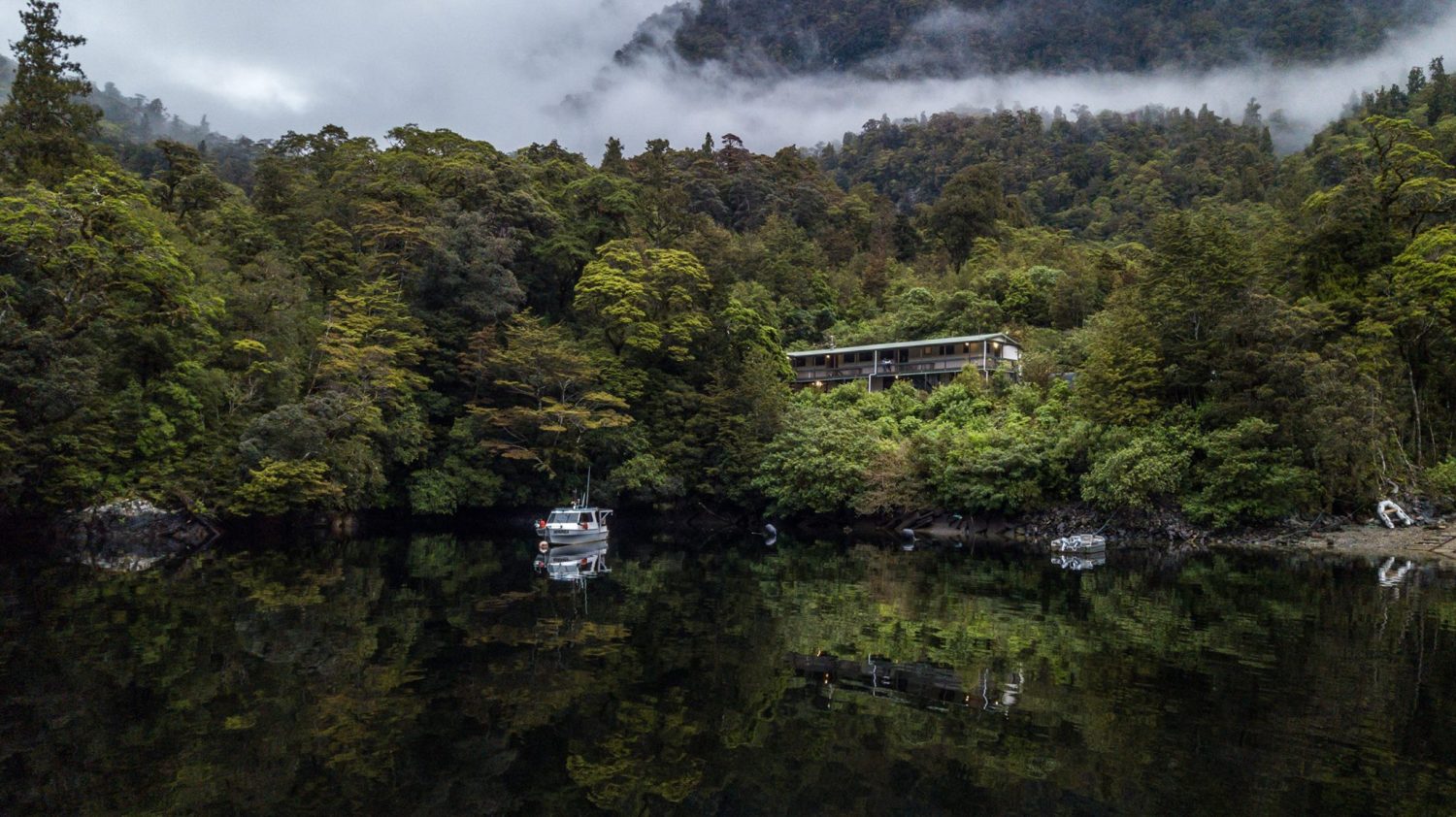
Deep Cove Outdoor Education Trust runs the Deep Cove hostel at the head of Doubtful Sound (Patea) in Fiordland National Park, Southland. Reached only by boat across Lake Manapōuri and a coach over the Wilmot Pass, it is one of the most remote places in the country for a Southland school camp, with free Nature Guide sessions built into every school booking. School groups stay in the trust’s 50-bed hostel, part of 76 beds on site.
Why schools choose Deep Cove
- A camp inside a national park: the hostel sits at the head of Doubtful Sound, surrounded by native podocarp forest, waterfalls and steep fiord walls.
- The journey is part of the camp: a boat from Manapōuri across the lake to West Arm, then a coach over the Wilmot Pass.
- Free Nature Guide programme: a Realnz Nature Guide runs conservation sessions with each school group, funded by the Leslie Hutchins Conservation Foundation.
- Built for schools: the trust is a non-profit set up in 1971, and the hostel is first and foremost a camp for school students.
- Tracks from the door: four walks start at or near the hostel, from a 20-minute nature trail to a steep climb to Huntleigh Falls.
- Time on the water: fishing, hostel dinghies in a sheltered area of the cove and a charter cruise on Doubtful Sound.
- Teaching resources: history articles, teacher information and the Discover Deep Cove app with a track map, quizzes and a knowledge base.
School camp accommodation
The trust has 76 beds across three buildings. Every building has a kitchen, dining area, fully enclosed bathrooms and hydro-generated power, with a diesel generator on standby.
Hostel
The 50-bed hostel is the school camp building, with its own kitchen and dining area for the group. On arrival the hostel manager briefs the class on how the stay will run.
Wilmot Lodge
Nine rooms with 20 beds in total, a gas and electric kitchen, a dining area with television, showers and toilets. Mattresses and pillows are provided.
Wanganella Apartment
Six beds with an electric kitchen, dining area and bathroom facilities. Mattresses and pillows are provided.
The hostel keeps only a small supply of duvets, sheets and pillowcases, for a charge, so students should bring their own bedding, plus warm layers, a good raincoat, sturdy footwear and insect repellent.
Facilities for school groups
- 50-bed hostel with kitchen and dining area.
- Hostel fishing dinghies for use in a designated area of Deep Cove, hired by the half day.
- Survival kits available at the hostel for every party member on trips away from the building.
- Handheld radios and radio communication for emergencies.
- AED at reception.
- Resident hostel manager, with office hours of 8am to 5pm and help available around the clock in an emergency.
- Limited satellite WiFi, available for purchase and suited to light browsing and email.
Catering
Deep Cove is self-catering. There is no shop on site (the nearest is at Manapōuri), so schools bring all their food and cook in the hostel kitchen. All luggage, food and equipment travels in the lockers under the coach, so plan menus and packing to keep freight down.
Outdoor education programmes
Schools plan their own camp and bring their own staff. Booking transport with Realnz automatically books a Realnz Nature Guide, who arrives around midday on Day 2 and leaves around 3pm on Day 3. The programme is a collaboration between the trust, the Department of Conservation and Realnz. Weather permitting, sessions can include:
- Marine science
- A nature walk covering biodiversity, flora and fauna and people
- Wai Care stream life study
- Threats to the environment, and pests and solutions
- A night walk for glow-worms and kiwi
- How the land was shaped
- Human history
The trust’s website also hosts articles on the area’s history, from early Māori occupation and Captain Cook’s 1770 visit to sealers, explorers and the Wilmot Pass road.
Curriculum connections
A camp at Deep Cove fits well with education outside the classroom (EOTC) and can support learning in:
- Science: marine life and the fiord’s freshwater layer, stream health, forest regeneration and how glaciers shaped the land.
- Social Sciences: the human history of Doubtful Sound, from Māori occupation to exploration and the Manapōuri hydro scheme.
- Health and Physical Education: tramping, outdoor safety and preparing for wet, cold conditions.
- Education for sustainability: pest control and protecting native wildlife in a national park.
- Key competencies: managing self, relating to others and participating and contributing through shared hostel life in a remote place.
Activities on site and nearby
Walks
- Brasell Point: an easy 20-minute nature walk from the eastern end of the hostel, a good first introduction to the local plants and animals.
- Helena Falls Track: over the Lyvia River and a swing bridge to a loop of about 40 minutes, with views of the falls and regenerating bush.
- Doubtful Sound Track: part of the original walking route to the sound, climbing gently beside the Lyvia River and the Stella Burn past small waterfalls.
- Huntleigh Falls Track: formerly the Hanging Valley Track, a steep and sometimes muddy climb beside the Wanganella Stream with views over Deep Cove.
On the water
- Fishing from the shoreline, wharves (except the main wharf) and the hostel dinghies, with adults present and life jackets on.
- Dinghies within the designated area between Brasell Point and the main wharf.
- Doubtful Sound charter cruise of one or two hours from the Deep Cove wharf, usually on Day 3.
- Marine science sessions with the Nature Guide.
After dark
- Night walk with the Nature Guide to look for glow-worms and kiwi.
About Deep Cove Outdoor Education Trust
The Deep Cove Outdoor Education Trust is a non-profit organisation set up in 1971 to teach school students and visitors about conservation and environmentally friendly practices in Fiordland. Its casual accommodation for other visitors sits alongside the school hostel. Partners and funders have helped over the years, including Meridian Energy, the Department of Conservation and the Southern Trust, who funded the Helena Falls swing bridge in 2009, and the Leslie Hutchins Conservation Foundation, which sponsors the Nature Guide programme.
School camp rates
Hostel accommodation is charged per person per night, with a lower student rate than the adult rate and two teachers staying free. There are small per-group charges for cleaning materials and resources, and extras for half-day boat hire and WiFi. Transport is booked separately with Realnz, charged per person return from Manapōuri with two teachers free, and the Doubtful Sound cruise is a vessel charter for one or two hours. The standard coach seats 45, so larger groups need prior arrangement and an extra charge. Payment at Deep Cove is by eftpos or credit card only.
Example four-day camp
An example of how a school camp at Deep Cove could look (every camp is planned by the school, and Realnz confirms times):
- Day 1: Midday boat from Pearl Harbour, Manapōuri, to West Arm and coach over the Wilmot Pass, arriving mid-afternoon. Hostel briefing and the Brasell Point walk.
- Day 2: Doubtful Sound Track or Helena Falls in the morning. The Nature Guide arrives around midday for marine science and stream study, then a night walk for glow-worms.
- Day 3: Charter cruise on Doubtful Sound and more Nature Guide sessions until mid-afternoon. Fishing or dinghies later in the day.
- Day 4: Clean the hostel and pack, coach leaves mid-morning for West Arm and the boat back to Manapōuri.
Getting there
Deep Cove is not connected to the national road network. Groups travel to Pearl Harbour in Manapōuri, about 20 minutes from Te Anau and around two hours by road from Invercargill, then cross Lake Manapōuri by boat to West Arm and continue by coach over the Wilmot Pass road. The trip takes about two hours each way. Transport is booked through the Realnz Manapōuri school bookings team, and trips may be cancelled if snow or ice makes the pass unsafe.
Nearby attractions for school groups
- Doubtful Sound (Patea): one of Fiordland’s largest fiords, with waterfalls, dolphins and seabirds.
- Helena Falls: a tall waterfall across the cove from the hostel.
- Wilmot Pass: a lookout over Doubtful Sound on the road from West Arm.
- Manapōuri Power Station: the underground hydro station at West Arm, linked to the history of the Wilmot Pass road.
- Lake Manapōuri: a deep lake dotted with bush-clad islands, crossed on the way to camp.
- Fiordland National Park Visitor Centre: in Te Anau, a useful stop on the way in or out.
Other groups and events
- Casual visitors: Wilmot Lodge and Wanganella Apartment can be booked online for stays at Doubtful Sound.
- Large groups: other groups needing more space are asked to contact the trust.
- Boaties: moorings and fuel are available at Deep Cove.
Good to know
- Any school can book, but preference goes to Southland and Otago schools, and Year 7 and above. Younger groups are considered if space allows.
- At least one adult in each school group must hold a Deep Cove Familiarisation Certificate, gained after staying with a school group and completing a checklist and follow-up meeting.
- Adult to student ratios are at least 1:6 up to Year 8 and 1:8 from Year 9, kept at all times, including free time.
- Schools bring their own first aid kits, and adults must not drink alcohol during a school camp.
- Swimming in Doubtful Sound is not allowed, and life jackets are worn for any activity on or near the water.
- There is no mobile or landline coverage at Deep Cove. Mobiles may work as far as West Arm.
- Deep Cove gets around 7 metres of rain a year, and snow is possible on the tops even in summer.
- Groups do hostel duties set by the manager, take all rubbish out and sort recycling for the Realnz centre at Manapōuri.
- No religious content requirements apply to school groups.
Frequently asked questions
How many students can Deep Cove accommodate?
School groups stay in the trust’s 50-bed hostel. The standard coach from West Arm seats 45, so larger groups need prior arrangement with Realnz.
How do school groups get to Deep Cove?
By boat from Pearl Harbour, Manapōuri, across Lake Manapōuri to West Arm, then by coach over the Wilmot Pass road, booked through Realnz.
Is food provided at Deep Cove?
No. Deep Cove is self-catering, so schools bring all their food and cook in the hostel kitchen. The nearest shop is at Manapōuri.
What does the free Nature Guide programme include?
A Realnz Nature Guide joins the group from Day 2 to Day 3 for sessions such as marine science, stream life study, pests and solutions, human history and a night walk for glow-worms and kiwi.
Which schools can book Deep Cove?
Any school can book, with preference for Southland and Otago schools and for Year 7 and above. Younger groups are considered if space allows.
What supervision is required?
At least one adult in the group must hold a Deep Cove Familiarisation Certificate. Ratios are at least one adult to six students up to Year 8 and one adult to eight students from Year 9.
Is there mobile coverage at Deep Cove?
No. There is no mobile or landline service, but the hostel has radio communication for emergencies and limited satellite WiFi for purchase.
What should students bring?
Their own bedding, warm layers, a good raincoat, sturdy footwear and insect repellent. Food and luggage must fit in the coach lockers.