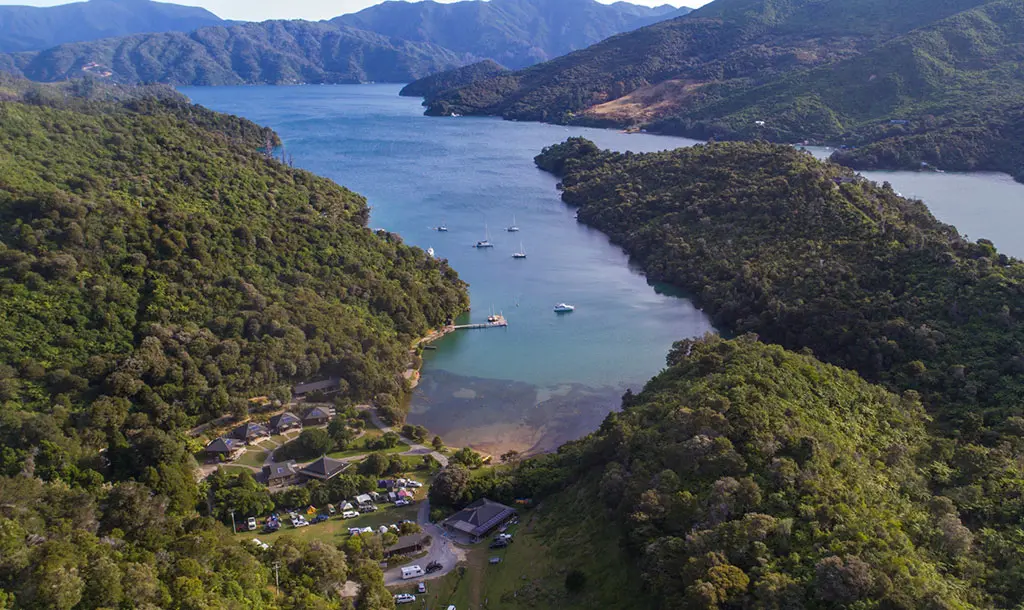
Mistletoe Bay Eco Village is a not-for-profit school camp venue on the shores of Onahau Bay in Queen Charlotte Sound (Tōtaranui), Marlborough Sounds. Set in regenerating native bush on Department of Conservation reserve land, it combines waterfront cabin accommodation and a large campground with a classroom, catering kitchens, a wharf and a programme of hands-on outdoor and marine education. Profits from the village’s commercial side fund a 40% discount for schools, so the camp is designed to be affordable for primary, intermediate and secondary groups alike.
Why schools choose Mistletoe Bay
- Discounted school rates – a 40% school discount, funded by the Mistletoe Bay Trust, plus one free adult for every five students.
- Two ways to stay – ensuite waterfront cabins (whare) or budget-friendly camping on grassed sites.
- A real outdoor classroom – old-growth native forest, a freshwater stream, a sheltered beach and rocky seashore, all within walking distance of your accommodation.
- Specialist education programmes – marine and forest ecology sessions with an experienced marine educator.
- On-site water activities – Optimist sailing, kayaking, stand-up paddle boarding and swimming in a sheltered bay.
- Sustainability you can see – solar hot water, rainwater collection and on-site wastewater treatment give students a working example of low-impact living.
- Easy access from Picton – reachable by road or a short water taxi ride across Queen Charlotte Sound.
School camp accommodation
Waterfront cabins (whare)
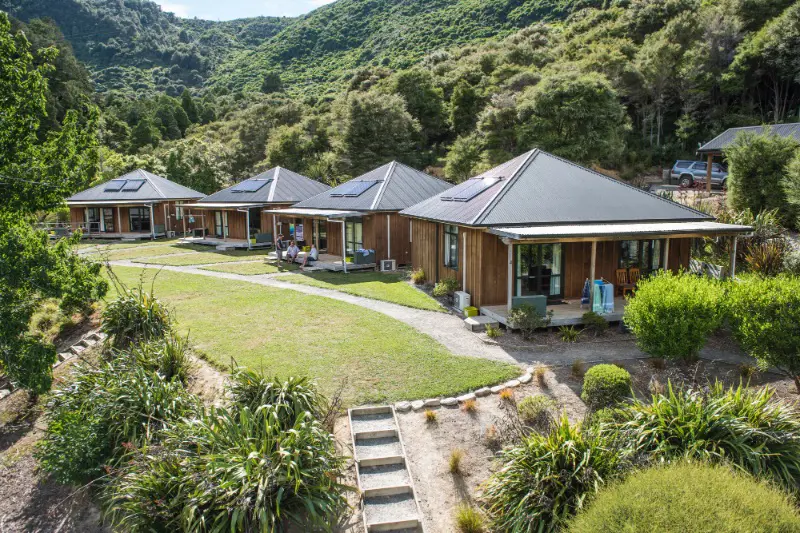
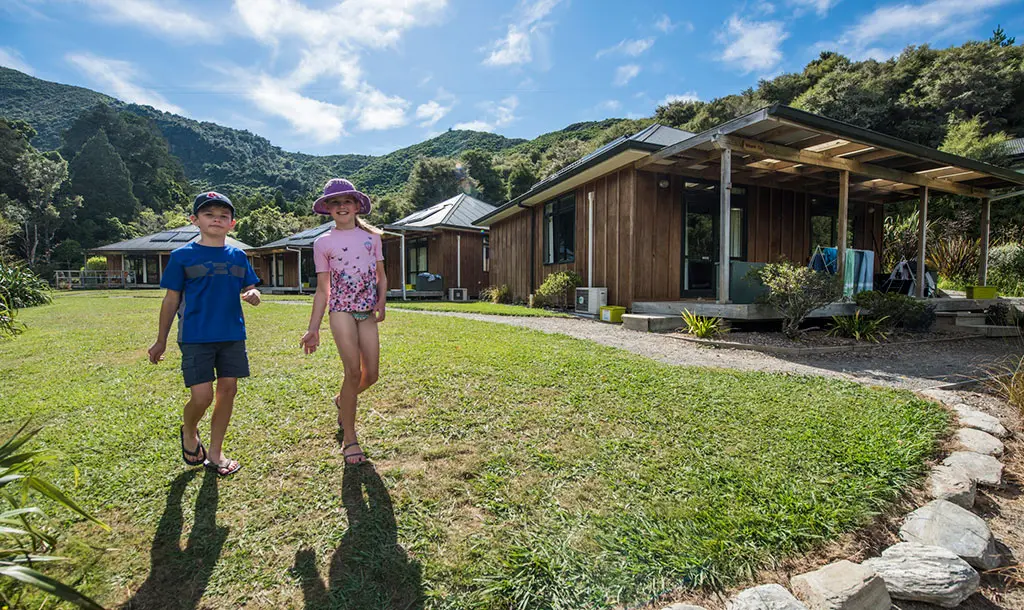
Eight waterfront whare, each named after a local bird, insect, plant or fish, sleep up to six people – two double beds and two single bunks – giving room for up to 48 people in total. Every whare has its own ensuite, a lounge and a dining area, with double glazing, insulation, heat pumps for heating and cooling, and solar water heating. One whare is wheelchair accessible. Groups staying in the whare have use of the fully equipped commercial kitchen.
Camping
The campground has 40 unpowered sites on tended lawns, close to the ablution block with toilets and hot showers. Camping groups use the large camp kitchen and the four-burner gas BBQ directly outside it. Camping is the most economical option and suits larger groups or schools wanting a classic tents-and-campfire-stories camp.
Vogel Cottage
A two-bedroom cottage (one queen, four single bunks) with its own full kitchen, lounge, heat pump and log burner. It sleeps up to six and can be a useful base for teachers, parent helpers or a smaller group.
Students bring their own sleeping bags, pillowcases and towels. Camping groups also bring their own crockery, cutlery, pots, pans and tea towels.
Facilities for school groups
- Classroom with multimedia equipment, log burner and heat pump – ideal for briefings, wet-weather sessions and evening activities.
- Commercial kitchen (whare groups) suitable for catering for up to around 60 students, either self-catered by parent helpers or by an outside caterer.
- Camp kitchen (camping groups) with stoves, microwaves, toasters, fridges, sinks, dining tables and a log burner – a warm gathering space in any weather.
- Function room opening onto a large veranda, with projector, screen, audio system and visualiser.
- Ablution block with toilets and hot showers for campers.
- Laundry and drying room – handy for wet gear after a day on the water.
- Pontoon wharf and jetty for water taxis, school charter boats, fishing and swimming.
- On-site shop for hot drinks, ice blocks and basic supplies.
- Grassed open spaces and beachfront for games, group activities and gatherings.
Outdoor education programmes
Mistletoe Bay works with marine educator Richard de Hamel (Marine Maestro), who holds a Masters in Zoology and spent around 20 years as a specialist marine educator for the University of Otago in Nelson and Marlborough, alongside work with museums, aquariums and the Department of Conservation. His sessions are hands-on, need no writing and no prior knowledge, and run for 1.5–2 hours. They can be combined, adapted to your group, or run as evening sessions.
Programmes include:
- Before Dinosaurs – an exploration of ancient life and Aotearoa’s natural history.
- After Dark – a night-time session exploring nocturnal life, including glow worms and phosphorescence.
- Māori Fishing Technology – traditional fishing methods and the knowledge behind them.
- Rocky Shore Critter Crawl – discovering crabs, starfish, shellfish and other seashore life.
- Going Wild about Nature – forest ecology and native wildlife.
- How to Not Get Too Lost – navigation skills for the outdoors.
- Predator Trapping & Monitoring – practical conservation and how predator control protects native species.
- Life Below the Waves – the marine life of the Marlborough Sounds.
- Optimist Sailing – learning to sail in a sheltered bay.
Sample camp programmes for Years 5–8 are available from the provider to help with planning, along with a risk management plan and camp rules – useful for EOTC paperwork and board approval.
Curriculum connections
A camp at Mistletoe Bay fits naturally with education outside the classroom (EOTC) and can support learning in:
- Science – marine and forest ecosystems, adaptation, food webs, the rocky shore, and human impacts on the environment.
- Health and Physical Education – outdoor skills, water confidence, teamwork, resilience and safety.
- Social Sciences – sustainability, conservation and how communities care for shared places.
- Te ao Māori – traditional fishing technology and kaitiakitanga (guardianship of the environment).
- Technology and Maths – navigation, orienteering and the eco village’s energy, water and waste systems.
Activities on site
On the water
- Optimist sailing – six Optimist yachts available for school groups (a qualified instructor is required and can be arranged).
- Kayaking – ten kayaks available to hire for the day in the sheltered bay.
- Stand-up paddle boarding – four paddle boards available for day hire.
- Swimming from the beach or off the jetty.
- Fishing from the jetty and at spots along the Peninsular Track.
- Guided sea kayaking – half- and full-day trips in Queen Charlotte Sound can be arranged with local operators.

Walks and tramping
- James Vogel Track – a 45-minute forest loop from the campground, through mature native bush.
- Peninsular Track – around one hour from the beachfront, with views over Mistletoe Bay and Waterfall Bay.
- Onahau Point Lookout – via the James Vogel Track and the Queen Charlotte Track, with views across Queen Charlotte and Kenepuru Sounds.
- Queen Charlotte Track day hikes – longer walks of 1–4 hours to Torea, Lochmara or Anakiwa, with water taxi returns available. Mistletoe Bay sits on the track, 12.5 km (about four hours’ walk) from Anakiwa.
Orienteering and team challenges
- Rogaining / orienteering – a permanent course with a full kit set up for schools.
- Team building – facilitated sessions can be arranged through local providers.
- Mountain biking – bring bikes or hire locally to ride sections of the Queen Charlotte Track.
After dark
Glow worms light up the driveway at night, and phosphorescence often glows in the water around the wharf, responding to touch – a highlight for many students and a natural lead-in to the After Dark session.
Wildlife and the seashore
The rocky shoreline is home to crabs, cockles, mussels and starfish, while the bush and bay attract weka, tūī, korimako (bellbirds), kōtare (kingfishers), pīwakawaka (fantails), shags and gannets. Dolphins, seals and little blue penguins are seen in the wider bay, and orca are occasionally spotted.

A working eco village
The Mistletoe Bay Trust was formed in 2003 as a not-for-profit charitable trust, taking on the management of the Mistletoe Bay Reserve and campground under an agreement with the Department of Conservation. The village was built around three pillars – conservation, education and environmental sustainability. Accommodation is double glazed and insulated, hot water is solar heated, rainwater is collected from every building, and treated wastewater from the on-site plant is reused to flush toilets. Visitors take their rubbish home, aluminium is crushed and glass is recycled. Students see these systems working day to day, which makes sustainability lessons concrete. An eco village tour and talk on the Trust’s story can also be arranged.
School camp rates
Mistletoe Bay offers dedicated school rates that include a 40% discount, with whare and camping options priced per student per night. One adult stays free for every five students (up to six free adults), and additional adults are charged at the student rate. Activities, equipment hire and education programmes are booked separately at modest group rates. Contact the provider for current school rates and availability.
Example three-day camp
An example of how a Year 5–8 camp could look (programmes can be tailored to your group):
- Day 1: Arrive by water taxi from Picton, settle in, James Vogel Track forest walk, Rocky Shore Critter Crawl, After Dark glow worm session.
- Day 2: Optimist sailing and kayaking rotations, rogaining course, Predator Trapping & Monitoring session, evening in the classroom.
- Day 3: Peninsular Track walk, Māori Fishing Technology session, eco village tour, pack up and depart.
Getting there
Mistletoe Bay is in Onahau Bay, Queen Charlotte Sound. By road, it is reached from Queen Charlotte Drive (between Picton and Havelock) via Kenepuru Road and Onahau Road – note that roads in the Sounds are narrow and winding, so allow extra time for buses. Many groups arrive by water taxi from Picton, a short trip across the Sound that becomes part of the adventure. The wharf can take commercial vessels and charter boats. Groups walking the Queen Charlotte Track can also arrive on foot.
For schools travelling from the North Island, the Interislander and Bluebridge ferries arrive in Picton, making Mistletoe Bay a practical first stop on a South Island camp or education tour.
Nearby attractions for school groups
- Queen Charlotte Track – one of New Zealand’s best-known multi-day walking and biking tracks, passing right through Mistletoe Bay.
- Meretoto / Ship Cove – the historic anchorage used by Captain James Cook on his voyages, at the northern end of the Queen Charlotte Track.
- Motuara Island – a predator-free bird sanctuary in outer Queen Charlotte Sound, visited on cruises from Picton.
- Kaipupu Wildlife Sanctuary – a predator-fenced mainland island near Picton, with a loop walk and native birdlife.
- Edwin Fox Maritime Museum, Picton – home to one of the world’s oldest surviving merchant sailing ships, with links to early immigration to New Zealand.
- Lochmara – a bay further along Queen Charlotte Sound with an underwater observatory, reachable on foot or by water taxi.
- Omaka Aviation Heritage Centre, Blenheim – WWI and WWII aircraft displays, a strong option for history and technology studies.
- The Link Pathway – a cycling and walking trail between Picton and Havelock that can be done in shorter sections.
Other groups and events
Outside school camps, Mistletoe Bay hosts a wide range of groups and can be booked in part or as a whole-village hire:
- Conferences, workshops and corporate retreats – a purpose-built function room with log burner, heat pump, veranda, projector, screen, audio system, visualiser and lectern, with accommodation for around 48–60 people.
- Weddings and celebrations – the function room holds up to 70 guests, with ceremony options on the waterfront lawn, the jetty or in a marquee.
- Sports clubs, youth groups and church groups – affordable shared accommodation, a large camp kitchen and plenty of space for group activities.
- Family reunions and group holidays – a mix of whare, Vogel Cottage and camping suits extended families.
- Walking and biking groups – a natural overnight stop on the Queen Charlotte Track.
- Team building – sea kayaking, guided walks, archery, dolphin tours, yacht hire and facilitated team challenges can be arranged with local operators.
Good to know
- Check-in is 2pm and check-out 10am; other times can be arranged.
- Mobile coverage is limited – a good opportunity for a device-free camp.
- Mistletoe Bay is on DOC reserve land, so dogs and other pets are not permitted.
- All rubbish must be taken away when you leave.
- Water activities depend on weather and wind conditions in the bay; life jackets are provided and must be worn.
Frequently asked questions
How many students can Mistletoe Bay accommodate?
The eight waterfront whare sleep up to 48 people, and Vogel Cottage sleeps a further six. The campground has 40 unpowered sites for larger groups. The commercial kitchen can cater for up to around 60 students.
Is there a discount for schools?
Yes. The Mistletoe Bay Trust funds a 40% discount for school groups, and one adult stays free for every five students (up to six free adults).
What age groups is Mistletoe Bay suitable for?
It suits primary, intermediate and secondary schools. Sample programmes are available for Years 5–8, and education sessions can be adjusted for younger or older students.
What activities are available for school camps?
Optimist sailing, kayaking, paddle boarding, swimming, fishing, bush walks, Queen Charlotte Track hikes, rogaining and orienteering, rocky shore exploration, glow worm and phosphorescence night walks, and specialist marine and forest education sessions.
Can we cater for ourselves?
Yes. Whare groups have a fully equipped commercial kitchen and camping groups use a large camp kitchen with BBQ. Outside caterers can also be used.
How do we get to Mistletoe Bay?
By road via Queen Charlotte Drive and Kenepuru Road, or by water taxi from Picton. The wharf can take water taxis and charter vessels.
Is Mistletoe Bay accessible?
One whare is wheelchair accessible. Some walking areas used in education sessions have limited wheelchair access, so discuss your group’s needs when booking.

Author: Bruce & Zeph
Photos
Mistletoe Bay school camp