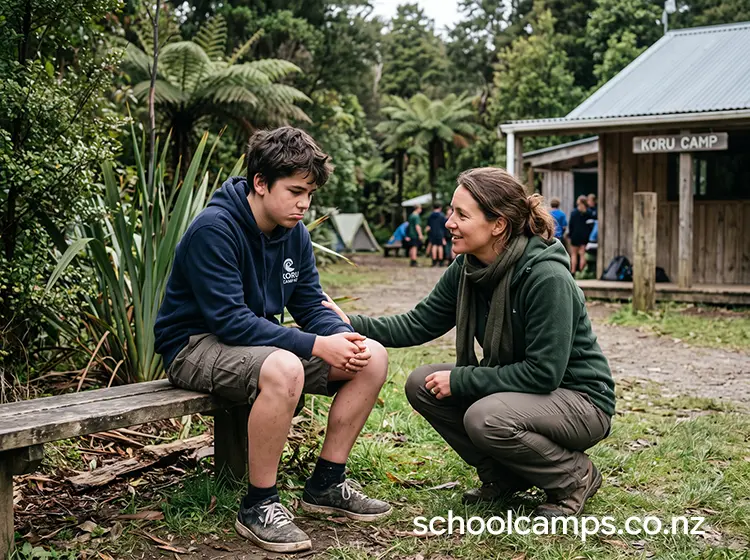
 Outdoor environments require different behaviour management approaches than classrooms. This guide provides practical strategies for managing student behaviour during water and land-based activities (paddling, climbing, tramping, archery, horse riding) in ways that maintain safety while supporting learning and engagement.
Why Outdoor Behaviour Management Differs
Outdoor activities bring different challenges than the classroom: safety risks are immediate and consequential, students are physically spread out (making individual intervention harder: whether that’s spread across a lake or strung out along a track), environmental factors (wind, cold, heat, fatigue) affect behaviour, novel experiences can trigger fear or overexcitement, and traditional classroom consequences don’t apply.
Clear, Simple Rules
Establish non-negotiable safety rules before the activity begins. The exact rules depend on the activity, but the pattern is the same:
- Listen-first rule. When the whistle blows or an instructor/teacher speaks, stop what you’re doing immediately (paddling, climbing, walking, shooting) and look toward the speaker. This is essential for emergency communication in any outdoor setting.
- Stay within boundaries. No exceptions without explicit permission. On water this means the marked paddling area; on a track it means staying with the group and not running ahead or lagging out of sight; on a climbing wall it means staying behind the marked line until it’s your turn. Going beyond boundaries means immediate end of session for that student.
- Hands to self around gear and equipment. No hitting with paddles, swinging ropes, pointing bows at people, or roughhousing around horses or climbing equipment. Every one of these activities requires calm, controlled movements around gear that can hurt someone if misused.
- Safety equipment stays on and fastened. PFDs on water, harnesses and helmets while climbing, hard hats and correct footwear around horses. No loosening straps or removing safety gear without an instructor’s say-so.
Handling Different Behaviour Profiles
Risk takers (students who push boundaries or show off)
On water these students may paddle beyond boundaries or intentionally capsize; on a climbing wall they may bounce, swing, or unclip early; on a tramping track they may run ahead out of sight; around horses they may move suddenly or ignore handling instructions.
Strategies: immediate, calm redirection (“That behaviour isn’t safe. Stay alongside me for the next 10 minutes so I can see you’re back in control.”); channel energy positively (“You’re clearly strong on this: I need you to help lead the group to the next marker/take the next pitch/set the pace up front.”); natural consequences if behaviour continues (“You’ve chosen to sit this out. You’ll observe from the side and we’ll talk afterward about what needs to change for next time.”); prevention by giving these students leadership roles early that channel their energy productively.
Refusers (students who are anxious, hesitant, or don’t want to participate)
These students may refuse to get in a craft or on a wall, hang back on a track, or express strong fear around a horse.
Strategies: acknowledge feelings (“It’s normal to feel nervous about this. Let’s start with watching and seeing how it goes for others.”); offer graduated entry (“How about you go with me and another confident student, on a more stable craft / an easier route / at the back with an adult?”); provide meaningful alternative roles (navigation, timekeeping, photography, belaying support, safety observer: ensure they’re still part of the experience); never force participation, since coercion creates trauma and undermines all future outdoor education. Celebrate small steps forward.
Disengaged students (seem bored, make minimal effort, complain)
Strategies: connect to their interests (“You’re good at noticing details. Help me identify birds we see along the shore.”); introduce challenge (“Let’s see if you can paddle in a perfectly straight line for 50 metres.”); check for hidden barriers, since disengagement can mask fear, cold, or fatigue.
Positive Reinforcement Strategies
Outdoor settings need proactive, specific positive feedback:
- Specific verbal praise: “I noticed how you kept your strokes smooth even when the wind picked up. That’s real skill development.”
- Public acknowledgement of teamwork: “This pair has been communicating brilliantly. Other groups, watch how they’re coordinating.”
- Increased responsibility as reward: “You’ve shown excellent judgment today. I’d like you to help brief the next group on boundary markers.”
- Group celebration: at session end, a quick round where each student shares something their partner did well. This builds a culture of mutual respect.
Prevention Strategies
Preventing issues before they happen is easier than managing them on the water:
- Clear expectations before activity: brief thoroughly on shore. Students should be able to repeat back the rules.
- Strategic partner pairing: mix confident with nervous, experienced with beginners. Avoid pairing two risk-takers or two anxious students.
- Keep students engaged: boredom breeds unsafe behaviour. Have backup challenges ready if activities finish early.
- Monitor for fatigue and cold: tired, cold students become irritable and unsafe. Build in mandatory rest breaks.
- Maintain consistent adult presence: students behave better when they know adults are watching and engaged.
When Behaviour Crosses Safety Lines
Some behaviours require immediate intervention: removing safety equipment without permission: a PFD on water, a harness or helmet while climbing (immediate return to shore/ground, activity ends for that student); intentionally endangering others: capsizing another craft, letting go of a belay rope, spooking a horse (immediate removal, serious conversation); ignoring boundary markers repeatedly (one warning, then removal from activity); using equipment as a weapon: a paddle, an arrow, a rope (instant removal, possible exclusion from future activities).
Framework for consequences:
- Warning: “That behaviour is not safe. This is your warning.”
- Removal: “You’ve chosen to sit out. We’ll talk about this later.”
- Restorative conversation: What happened? What were you thinking? Who was affected? How can we make this right? What will you do differently next time? (For more on restorative practices, see Restorative Justice NZ.)
- Path back: clear conditions for re-entry to activities (apology, demonstrated change, probationary period)
Communicating Consequences to Parents
If a student is removed from an activity for safety reasons: contact parents the same day if possible, certainly within 24 hours; be factual (“Your child was removed from paddling today because [specific behaviour]. We need to ensure everyone’s safety.”); frame positively where possible (“We want to support your child to participate safely. Here’s our plan…”); document the incident and parent conversation.
Special Considerations for Neurodivergent Students
Provide clear, step-by-step visual demonstrations (some students struggle with verbal-only instructions in busy environments); use consistent verbal cues (same words each time for stop, go, turn); allow students to observe before participating if sensory overwhelm is a concern; offer noise-reducing headphones during loud briefings if needed; build in decompression time if a student needs breaks from social intensity.
Remember: behaviour that looks like defiance may be anxiety, sensory overload, or difficulty processing information in an unfamiliar environment.
For additional support strategies for neurodivergent learners, see Altogether Autism and ADHD New Zealand.
Leave a Reply
You must be logged in to post a comment.