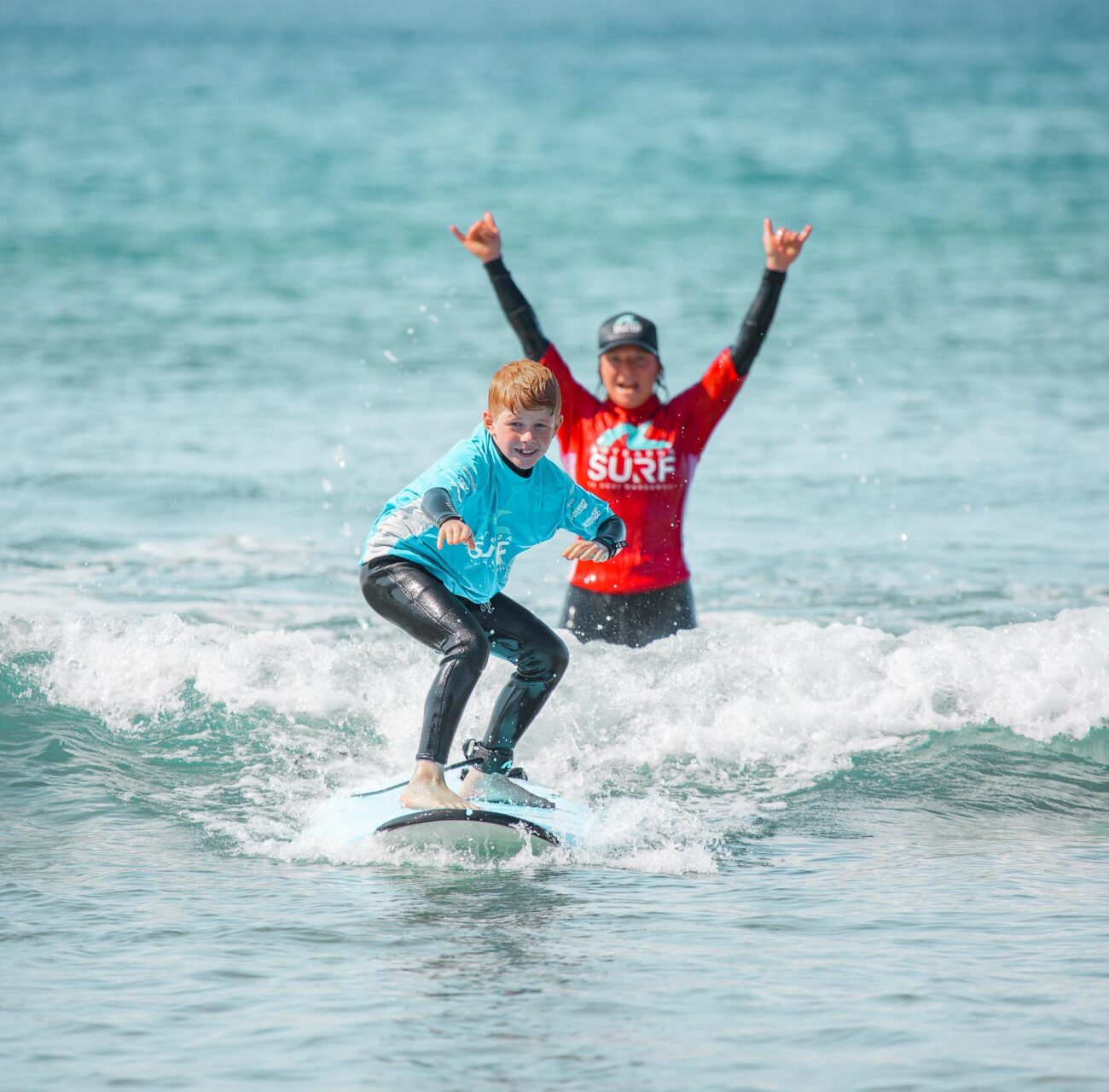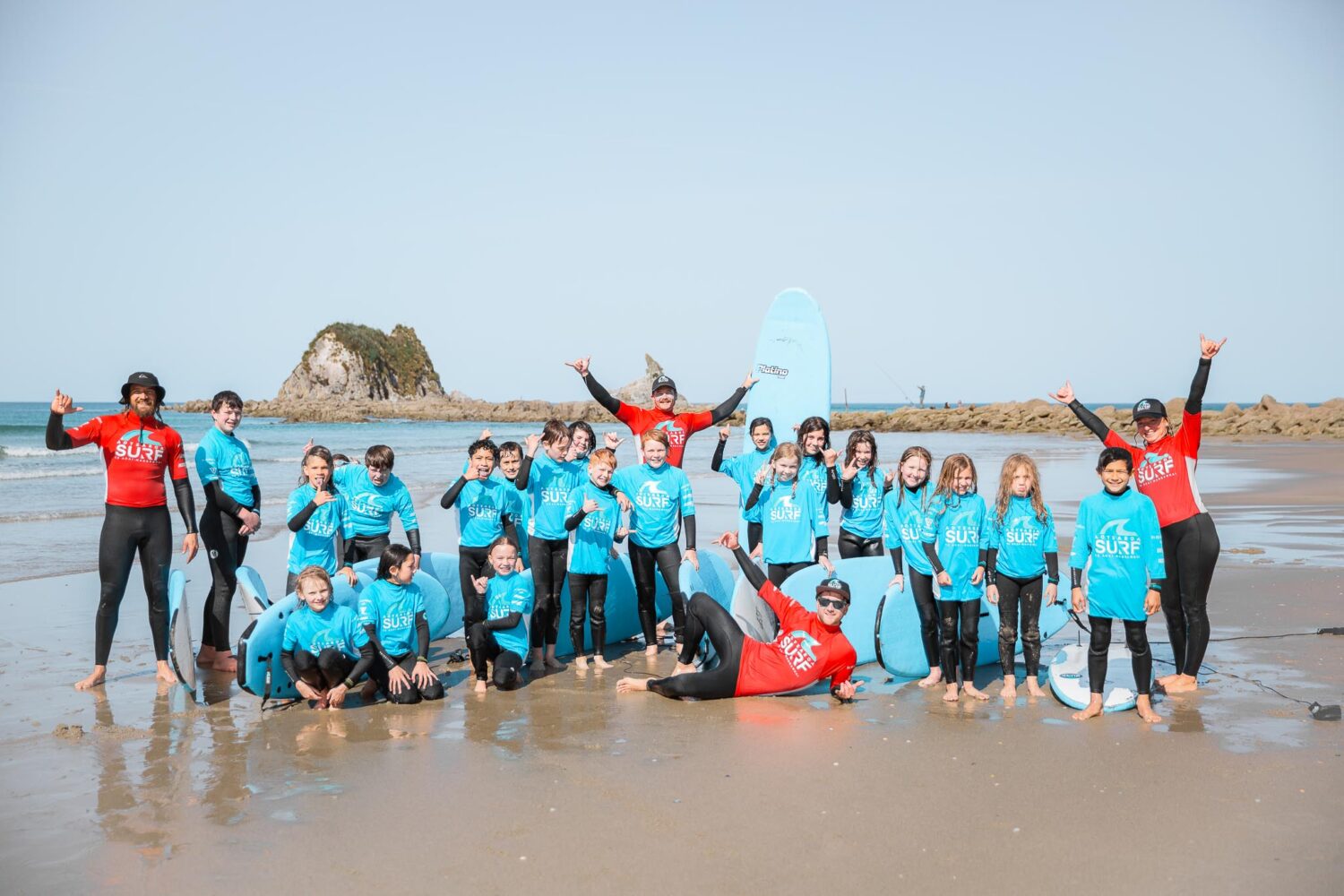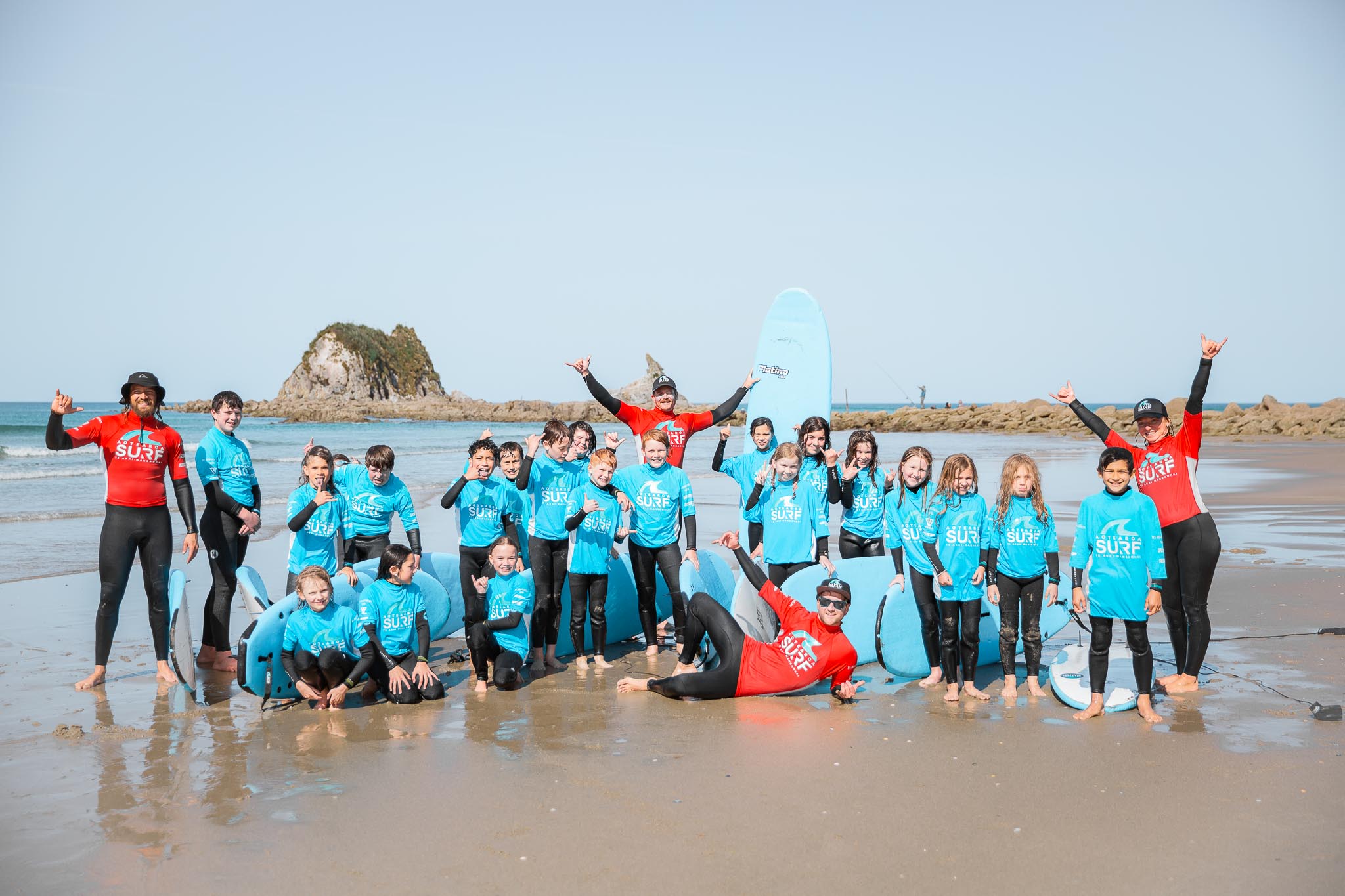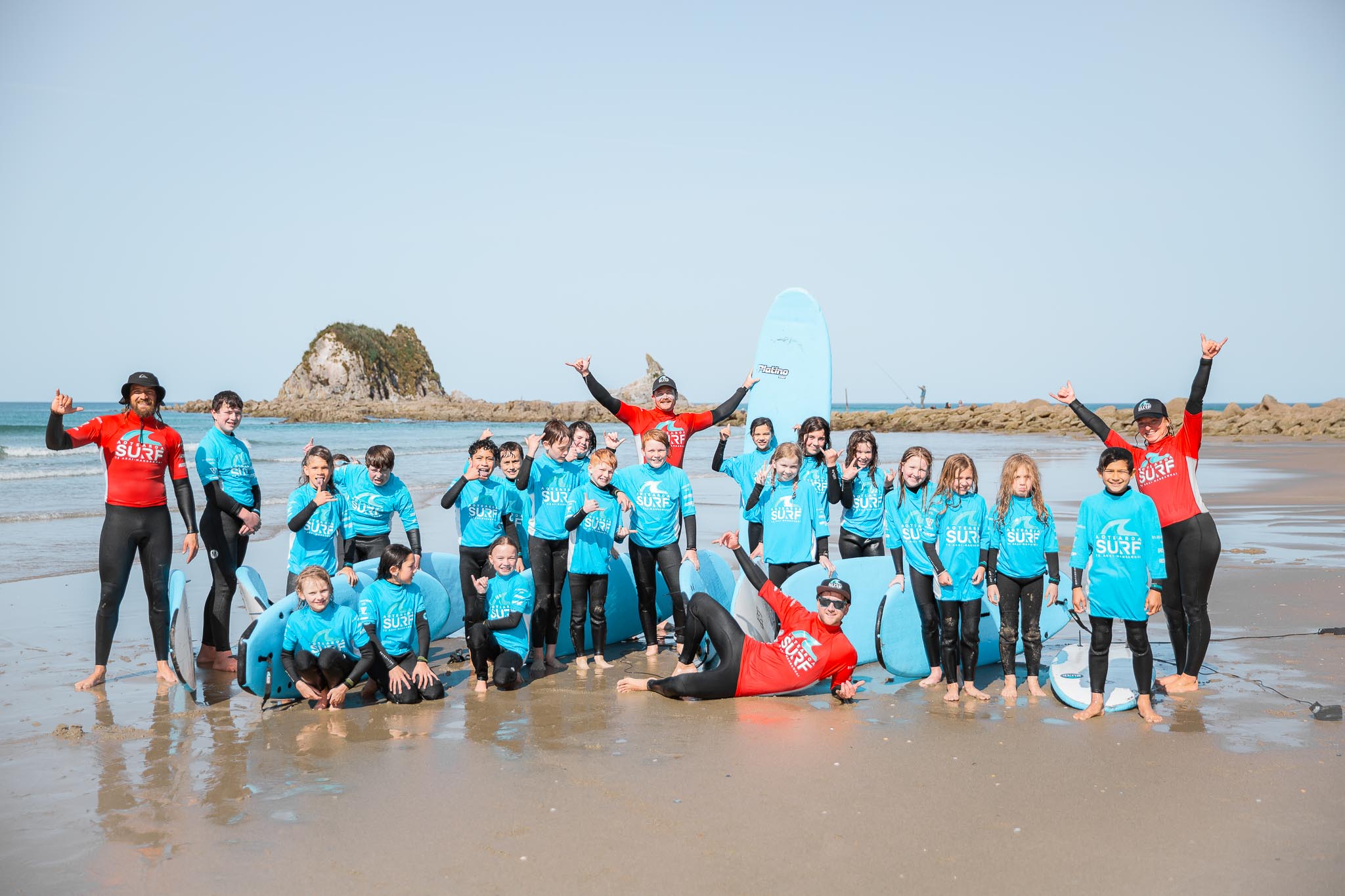
Aotearoa Surf School – Northland brings surfing, paddling and beach learning to primary, intermediate and secondary schools along the Northland coast, from its home beach at Mangawhai Heads and nearby Te Arai up to Ruakākā, Matapouri and Ahipara. For a Northland school trip it can run a single day at the beach, a progressive programme over several days, or a fully hosted overnight camp at Mangawhai or Te Arai for 6 to 130 students, with instructors, equipment and safety planning supplied so staff workload stays light. Day programmes take 4 to 100 students.
Why schools choose Aotearoa Surf in Northland
- Northland beaches covered: sessions run at Mangawhai, Te Arai, Langs Beach, Ruakākā, Matapouri, Matauri Bay, Taupō Bay and Ahipara, so many schools can stay close to home.
- Three kinds of water at Mangawhai: an open surf beach, a sheltered estuary and Picnic Bay sit within walking distance, which gives options when conditions change.
- Day trip to full camp: single days, multi-day progressive programmes and overnight camps can be combined to suit the school’s EOTC plan.
- Gear included: wetsuits in every size, soft learner boards, rash shirts, sunscreen and the equipment for water and land activities.
- Small in-water groups: one instructor to between four and eight students, with tighter numbers for younger students and non-swimmers.
- Planning support: risk management documents, a proposal agreement and emergency procedures are supplied before the day.
- Local school experience: schools such as Whangārei Intermediate, Ahipara School and Mangawhai Beach School have used the programmes.
School programmes and activities
Single-day beach programmes
Half days of around two and a half to three hours suit groups of 4 to 60 students and combine a surf lesson with beach safety. Full days run through the school day (roughly 9.45am to 2pm) for up to 100 students, with the class split into two or three rotating stations. Depending on the beach and the conditions, a day can include:
- Surfing for every ability level
- Stand up paddleboarding and kayaking
- Snorkelling and exploring the coastline
- Beach safety, including how rips and currents work
- Beach games and challenges that build confidence
- Team building and leadership activities
Progressive surf programmes
Programmes of one to five days build surfing skills step by step. They can run as day sessions, as an elective or as part of a camp. NCEA standards for senior students are delivered across multi-day programmes or overnight camps.
Multi-day and overnight school camps
Schools can also book overnight camps of two nights and three days or longer, held at Mangawhai or Te Arai depending on group size and accommodation availability, with three accommodation options. Overnight camps take 6 to 130 students. The school arranges transport to the camp and back, and Aotearoa Surf handles everything else: accommodation, all meals, daily surfing and activities, equipment and safety documents, along with supervised evening programmes and night activities. Qualified instructors and camp staff run a structured daily timetable with full supervision, backed by Aotearoa Surf’s safety systems and risk management. These camps are described in full on the separate Aotearoa Surf Camp – Mangawhai listing.
Activities at your own camp
For Northland schools already booked into a camp on the coast, instructors can bring surf and beach sessions to the camp’s beach, priced per student per activity.
Year levels
Programmes are shaped for primary, intermediate and secondary students from Year 1 to Year 13.
Learning opportunities
Aotearoa Surf designs its school sessions around confidence, teamwork, resilience and a stronger connection with the coast, learned through doing rather than in a classroom. Sessions are mapped to the Health and Physical Education curriculum and to Water Skills for Life, and are aligned with the new 2027 curriculum for Years 7 to 10, with teacher sign-off sheets provided.
Curriculum connections
A Northland beach day or camp with Aotearoa Surf sits within education outside the classroom (EOTC) and can support:
- Health and Physical Education: movement and balance, managing challenge and risk, and outdoor education.
- Water Skills for Life: water confidence, reading the beach, recognising rips and knowing how to stay safe in the surf zone.
- Science: tides, waves, estuaries and coastal life on Northland’s east and west coasts.
- Key competencies: managing self, relating to others, and participating and contributing in team challenges.
- New 2027 curriculum: alignment for Years 7, 8, 9 and 10, with teacher sign-off sheets.
- NCEA: standards for senior students, delivered across multi-day programmes or overnight camps.
Safety and instruction
Sessions are led by qualified, experienced instructors who hold International Surfing Association (ISA) qualifications, first aid training and surf lifesaving awards, and every staff member on school programmes is Police vetted. Aotearoa Surf has run surf lessons since 2002 and is Qualmark Gold, recognised by Surfing New Zealand and accredited by Water Safety New Zealand.
- In-water ratios of 1:4 to 1:8, set by age, ability and confidence.
- Before each session instructors check the beach and mark out a supervised zone clear of rips and hazards, then keep reassessing through the day.
- Instructors supervise the activities, on the sand and in the water, while teachers and parent helpers handle pastoral care.
- A first aid kit goes to the beach every session, and emergency procedures cover each location, including the nearest medical facilities.
- Before the trip, schools receive dated, activity-specific RAMS with a hazard register, a proposal agreement, emergency procedures, an instructor qualifications matrix and Police vetting confirmation.
What to bring
Students bring togs, a towel, their lunch and warm clothes for after the session. Everything else, from wetsuits to sunscreen, is supplied.
Adding Aotearoa Surf to a school camp
Northland schools staying at a coastal camp can add a surf or beach session to their programme, either at a nearby beach or with instructors coming to the camp’s own beach. Schools that want the whole stay handled can book a hosted overnight camp at Mangawhai or Te Arai instead, where accommodation, meals and evening activities are included alongside the surf programme, and the school only needs to arrange transport.
About Aotearoa Surf
Aotearoa Surf began on a Northland beach in 2002 and is led by Che Burnett. Its headquarters is on Te Arai Point Road, just south of Mangawhai, with a surf school and lodge at Mangawhai Heads and eco pod and glamping accommodation behind the Te Arai dunes. Schools across Auckland and Northland use its programmes, and it also runs sessions at Orewa and Omaha and on Canterbury beaches.
School group rates
Aotearoa Surf publishes per-student pricing for each format:
- Half-day surf programme: 2.5 to 3 hours, up to 60 students, with all gear, instructors and safety documents.
- Full-day surf programme: 9.45am to 2pm, up to 100 students, with all gear, instructors and safety documents.
- Overnight school camp: two nights and three days or longer, with a per-student rate and a lower supervisor rate covering accommodation, all meals, daily surfing, all activities, equipment and safety documents.
- Small group surf camp: 1 to 4 nights for 6 to 40 people in eco pods or the surf lodge, with all activities and optional catering, priced per person per night.
- Camp activities at your venue: priced per student per activity, for a session, day or multi-day programme, with instructors, all equipment and activity RAMS.
Funded subsidies are available for overnight school camps and full-day surf programmes, and every proposal itemises exactly what the school pays for. Day programmes at remote beaches carry a transport charge. Contact Aotearoa Surf for current rates.
Example school visit
An example of how a school visit to Aotearoa Surf in Northland could look (every visit is planned with the provider):
Example day
- Arrival: the bus drops students at Mangawhai Heads, where they get into wetsuits and hear the beach safety briefing.
- First rotation: one group learns to surf on the open beach while another paddleboards or kayaks on the estuary.
- Lunch: packed lunches on the beach.
- Second rotation: groups swap, with beach games and team challenges for students out of the water.
- Finish: warm clothes on, a quick debrief and back on the bus by about 2pm.
Getting there
Mangawhai Heads is on Northland’s east coast in the Kaipara District, about an hour’s drive south of Whangārei and just over an hour north of Auckland. Te Arai is a short drive south. For schools further north, day programmes can be run at beaches such as Ruakākā, Matapouri, Matauri Bay, Taupō Bay and Ahipara, agreed when the programme is planned; a transport charge applies for remote locations. For overnight camps, the school arranges transport to Mangawhai or Te Arai and back. Other suitable Northland and Auckland coastal spots can also be discussed.
Nearby attractions for school groups
- Mangawhai Cliffs Walkway: a coastal loop over the headland and back along the beach.
- Te Arai Regional Park: dunes, lakes and long beaches south of Mangawhai.
- Waipū Museum: the story of the Nova Scotian Scottish settlers of Waipū.
- Kiwi North: museum, heritage village and kiwi house in Whangārei.
- Whangārei Falls: a 26-metre waterfall with short bush walks.
- Poor Knights Islands Marine Reserve: reached by boat from Tutukākā, known for diving and marine life.
- Te Oneroa-a-Tōhē (Ninety Mile Beach): the long west coast beach running north from Ahipara.
Other groups and events
Alongside schools, Aotearoa Surf runs programmes for youth and community groups and businesses, small group surf camps for 6 to 40 people at Te Arai or Mangawhai, and after-school and holiday programmes for children.
Good to know
- No surfing experience is needed. Lessons begin on the sand and move at each student’s pace.
- Non-swimmers stay in standing-depth water on high-buoyancy boards with a tighter ratio.
- Rain on its own doesn’t stop a session. If surf or wind is outside safe limits, a call is made the day before to use a sheltered beach, run a beach-based programme or reschedule without charge.
- Terms 1 and 4 fill up first, and Term 2 usually has more availability, so early booking is wise.
- Who supervises what is written into the RAMS and proposal agreement.
Frequently asked questions
Which Northland beaches does Aotearoa Surf work at?
Mangawhai is the home beach, with programmes also run at Te Arai, Langs Beach, Ruakākā, Matapouri, Matauri Bay, Taupō Bay and Ahipara.
Can a whole year level come on the same day?
Yes. Day programmes take 4 to 100 students, and full-day groups rotate between two or three stations so the number in the water stays small.
Do students need to be able to swim?
No. Non-swimmers stay in standing-depth water on buoyant boards with extra instructor support.
What is included in a school day?
Instructors, wetsuits, boards, rash shirts, sunscreen, activity equipment and the safety documents. Students bring togs, a towel, lunch and warm clothes.
Are overnight camps available in Northland?
Yes. Hosted overnight camps for 6 to 130 students run at Mangawhai or Te Arai and include accommodation, meals, activities and supervised evening programmes. The school arranges transport to the camp and back.
Can Aotearoa Surf come to our school camp?
Yes. Instructors can run surf and beach sessions at a school’s own camp, priced per student per activity.
What happens if the surf is too big?
A decision is made the day before. The session can move to a sheltered beach, switch to a beach-based programme or be rescheduled at no cost.
Can senior students earn NCEA credits?
Yes. NCEA standards are delivered across multi-day programmes or overnight camps. Ask about the standards when booking. For Years 7 to 10, programmes align with the new 2027 curriculum, with teacher sign-off sheets.