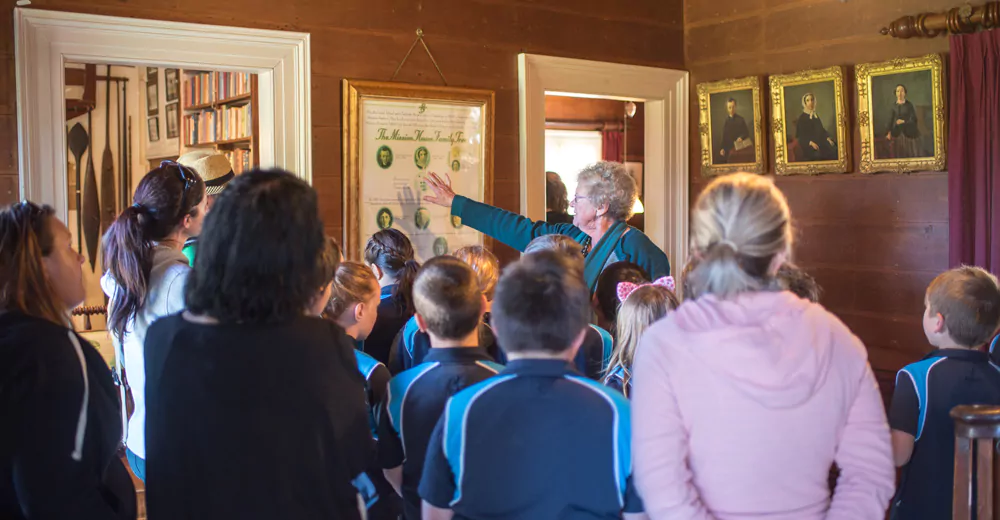
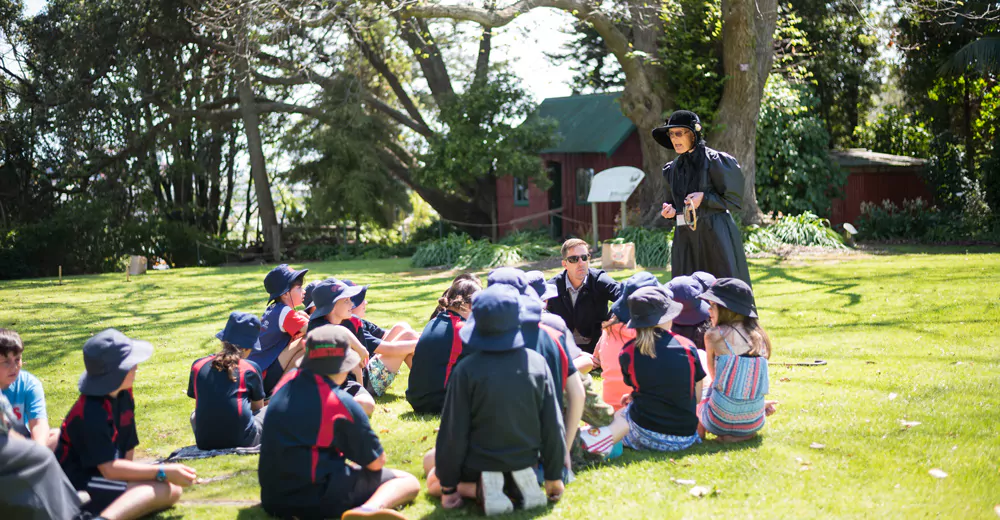
The Elms | Te Papa Tauranga is a historic mission site on the Te Papa peninsula in central Tauranga, Bay of Plenty, and one of the oldest heritage sites in New Zealand. Schools come for guided education programmes built around the mission house, Archdeacon Brown’s Library and the heritage gardens, mixing guided storytelling with hands-on activities about life in the 1800s and early contact between Māori and Pākehā. It’s a strong Tauranga school trip or Bay of Plenty school camp activity for any year level, with programmes tailored to the class and taken in groups of 10 students, each with an adult.
Why schools choose The Elms
- A nationally significant site: category one listed heritage buildings and nationally significant collections on a one-hectare property.
- The real buildings: the library, finished in 1838, and the mission house, completed in 1847.
- Tailored to the class: programmes adapt to year levels and learning outcomes, and teachers choose from a range of themes.
- Student-led discovery: students guide their own group around the site with a map and question sheet, meeting Elms Guides along the way.
- Strong history links: early mission life, cross-cultural encounters, and the battles of Pukehinahina/Gate Pā and Te Ranga.
- A Garden of National Significance: one of the oldest European gardens in New Zealand south of the Bay of Islands, recognised by the NZ Gardens Trust.
- Decades of school visits: school groups have been coming to The Elms for generations.
School programmes and activities
Student-directed Elms tour
The standard school visit. The class is split into groups of 10 students, each with a parent or teacher. Two students in each group take the lead, one holding a site map and the other a set of written guidelines, and the adult has a copy of the guidelines too. Groups work through questions and make their own discoveries around the property, while Elms Guides stationed in the Mission House, the Library and the Heritage Garden share the stories behind each place. The standard session runs for an hour, and optional activities of about 10 to 15 minutes each can be added on, depending on the age of the students and the time available. Games of the 1800s is the most popular add-on for all ages.
Larger groups
Up to 60 students can be on site at once. Larger groups are split in two: one half spends an hour at The Elms while the other explores the nearby heritage precinct with their teachers (this part isn’t led by Elms staff). The groups meet back for morning tea or lunch, then swap over.
One-hour house, library and heritage garden tour
A guided tour of about an hour, better suited to older students. It covers the early days of the mission and the site’s links to the battles of Pukehinahina/Gate Pā and Te Ranga.
Stops and themes around the site
Depending on the programme, students may visit:
- The cliff top facing Mauao: picturing the scene in 1848 and thinking about the future.
- The Coach House: finding and explaining old technology, such as a wooden wall telephone, a coach light and a primus.
- The front lawn: building whare and daily life at Te Papa in the 1840s and 1850s.
- The kauri house: how it was built and the story of the 1845 fire.
- Archdeacon Brown’s Library: the oldest building on the site, its taonga and how people wrote in the 1800s.
- Life in the 1800s: what young people did and the games children played.
- The taonga room and bedroom: some of the site’s most valued taonga and the stories attached to them.
- The heritage whare and garden: carvings and plantings acknowledging mana whenua, Ngāi Tamarāwaho and Ngāti Tapu.
- The food garden: food plants, including Captain Cook’s native spinach, which students can taste.
- The bell, the oak and the Norfolk pines: New Zealand’s oldest oak, the Archdeacon’s Sentinels and the travels of the mission bell.
- Native tree walk: medicinal plants, with a focus on karaka.
Learning opportunities
The Elms gives students an authentic setting to learn about settlement, cross-cultural encounters and the stories that have shaped Tauranga Moana and the Bay of Plenty. Guided sessions bring the lives of early missionaries and settlers to life, and the hands-on approach helps make history feel relevant and real, well beyond what a textbook can do.
Curriculum connections
Programmes connect with Social Sciences at all levels and work well as education outside the classroom (EOTC). A visit can support learning in:
- Social Sciences and Aotearoa New Zealand’s histories: the CMS mission, early contact between Māori and Pākehā, the New Zealand Wars in Tauranga and local identity.
- Science: heritage trees, native and medicinal plants, and mission-era food growing.
- Technology: building methods and everyday tools of the 1800s.
- Te reo Māori: place names, mana whenua and taonga.
- Mathematics and Health and Physical Education: the site describes its programmes as cross-curricular, including these areas.
- Key competencies: student-led groups build managing self, relating to others and thinking.
Safety and instruction
Sessions are led by trained Elms Guides, part of a volunteer team of more than 50 who guide visitors, care for the gardens and run the education programmes. Schools need at least one adult for every 10 students, and each group stays with its adult throughout. Pre-booking makes sure there are enough guides on site for the class.
What to bring
- Good walking shoes.
- Warm or wet-weather gear.
- Morning tea or lunch if you’d like to picnic on the lawn (take all rubbish away).
Students get more from the visit with some background knowledge of the site, and teachers should go over the ground rules with the class beforehand.
Adding The Elms to a school camp
For schools on camp in Tauranga or the wider Bay of Plenty, The Elms adds a heritage and culture session to a programme that is often focused on the beach and the outdoors. A student-directed tour or one-hour guided tour fits neatly into a morning or afternoon, and the Te Papa peninsula’s other historic places, such as Monmouth Redoubt and the Mission Cemetery, are close by for a fuller history day.
About The Elms
The site was once Otamataha pā. After it was abandoned, local chiefs invited the Church Missionary Society to set up a station at Te Papa, which was formally established in 1838 under Alfred Brown. The library was the first building completed, in 1838, followed by the mission house in 1847. In 1864 imperial troops camped on mission land and used the buildings as a commissariat during the fighting at Gate Pā and Te Ranga.
In 1873 Alfred Brown and his second wife Christina bought the house and land from the CMS and named it The Elms. The property stayed with the Brown and Maxwell families until 1997, and Alice Maxwell opened the house to visitors after 1919. The Elms Foundation, a registered charitable trust governed by a board of trustees, bought the property in 1999 and cares for it today.
School group rates
School visits carry a fee to cover programme coordination. It’s set at the time of booking and depends on student numbers, ages and training requirements. Free entry for accompanied children doesn’t apply to school groups. Contact The Elms | Te Papa Tauranga for current rates.
Example school visit
An example of how a school visit to The Elms could look (every visit is planned with the provider):
- Arrival: drop-off at the bus bay by the front gate, a welcome, a reminder of the ground rules and students split into groups of 10 with an adult.
- Student-directed tour (1 hour): groups explore the site with their map and questions, meeting Elms Guides in the Mission House, Library and Heritage Garden.
- Optional activities: one or two short add-on activities, such as Games of the 1800s or the native tree walk.
- Picnic lunch: on the lawn, taking all rubbish away. For groups of more than 60, this is when the two halves swap between The Elms and the heritage precinct.
- Older classes: the one-hour house, library and heritage garden tour can be used instead, focusing on the mission and the battles of Gate Pā and Te Ranga.
Getting there
The Elms is on Mission Street on the Te Papa peninsula, at the northern end of Tauranga’s city centre. There’s a dedicated bus bay directly at the front gate. For cars, there’s limited free time-restricted parking on Mission Street and a paid public car park nearby on Cliff Road. Mount Maunganui is a short drive across the harbour, and Rotorua and Hamilton are within comfortable day-trip range.
Nearby attractions for school groups
- Monmouth Redoubt: the site of Taumatakahawai pā and an 1864 British redoubt, a short walk away on the peninsula.
- Mission Cemetery: part of the Te Papa precinct, with graves from the mission and the New Zealand Wars.
- Te Awanui waka: a carved waka on the Tauranga waterfront, also part of the precinct.
- Pukehinahina/Gate Pā: the historic reserve where the battle of Gate Pā was fought in 1864.
- Mauao: the summit and base tracks of Mount Maunganui, with views over Tauranga Harbour.
- Tauranga Art Gallery: a public gallery in the city centre.
- McLaren Falls Park: a large park with walks, waterfalls and glow-worms, inland from Tauranga.
Other groups and events
The Elms is open to the public for guided tours of the house and library, with specialised garden tours by arrangement. Groups can book Devonshire teas after a guided tour, and the site is also available for weddings and venue hire.
Good to know
- Pre-booking is essential for school visits so enough guides are rostered on.
- Group size: a maximum of 60 students on site at once; larger groups split and swap with a teacher-led visit to the nearby heritage precinct.
- Buses: a dedicated bus bay is directly at the front gate.
- Term time and holidays: school bookings are taken during term and in the school holidays, subject to the schedule and weather.
- Weather: visits may be cancelled if the weather is too poor.
- Pre-visit: teachers can arrange a walk-through before the trip.
- Supervision: at least one adult per 10 students, and students stay in their groups at all times.
- Ground rules: no running, no climbing trees or walking through plant beds, no touching plants, no disturbing the shell and stone paths, no chewing gum and no food or drink inside the buildings.
- Access: heritage paths of crushed shell and stone and small steps into the house and library limit wheelchair access. An introductory talk under the trees can be arranged for anyone unable to enter the buildings.
Frequently asked questions
What year levels can visit The Elms?
Programmes are tailored to suit different year levels, from junior primary through to secondary. The one-hour guided tour is better suited to older students.
How are school groups organised on the day?
Classes are split into groups of 10 students, each with a parent or teacher, for a one-hour session. Two students in each group lead with a map and written guidelines, and Elms Guides share stories in the Mission House, Library and Heritage Garden. Short add-on activities such as Games of the 1800s can be included.
Which curriculum areas does a visit support?
Programmes connect with Social Sciences at all levels, particularly New Zealand history, and are cross-curricular, touching on science, technology, maths, physical education and te reo Māori.
Do we need to book a school visit?
Yes. Pre-booking is essential so there are enough guides on site. Bookings are taken in term time and the school holidays, subject to the schedule and the weather.
How many students can visit at once?
Up to 60. Larger groups are split in two, with one half at The Elms for an hour while the other visits the nearby heritage precinct with their teachers. The groups meet for morning tea or lunch on the lawn, then swap.
How much does a school visit cost?
A fee covers programme coordination and is set at booking based on numbers, ages and training requirements. Contact The Elms for current rates.
What happens if the weather is bad?
Visits can be cancelled if the weather is too poor. Students should bring warm or wet-weather gear and good shoes.
Where do school buses drop off?
There’s a dedicated bus bay directly at the front gate on Mission Street.

Author: Andrew Gregg
The Elms | Te Papa Tauranga, is one of New Zealand’s oldest heritage sites. As a place of early contact between Māori and Pākehā, this historic site remains at the centre of Tauranga’s history and identity today. Encompassing category one listed heritage buildings and nationally significant collections – all set within a diverse and tranquil garden setting – this one hectare property is a must-see destination for visitors to Tauranga.