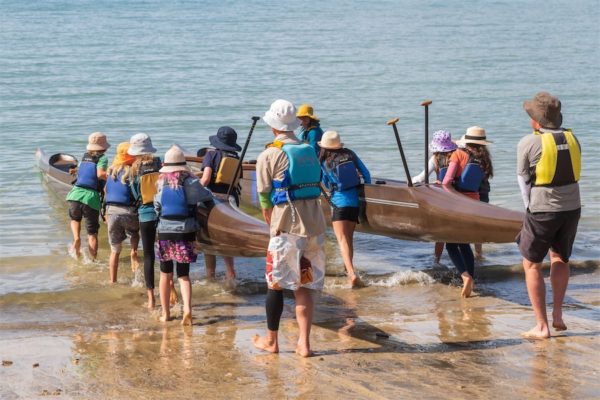
Waka Abel Tasman is a whānau-run waka tour operator based at the boat ramp in Kaiteriteri, Tasman, on the doorstep of Abel Tasman National Park. It takes school groups out on double-hulled waka, blending paddling with tikanga, karakia, te reo Māori and local stories, which makes it a distinctive Kaiteriteri school camp activity or Nelson Tasman school trip. Sessions suit school children of all ages, from Year 1 juniors on a short paddle inside the bay to secondary students on longer journeys, with groups of 4 to 44.
Why schools choose Waka Abel Tasman
- Te ao Māori on the water: each session opens and closes with karakia, with tikanga waka taught on shore before anyone paddles.
- Programmes by year level: short introductory paddles for younger learners and longer options, up to multi-day journeys, for high school students.
- Experienced kaihautū: the team includes national and international waka ama competitors with long backgrounds in adventure tourism.
- Curriculum-linked: the provider maps its programme to Health and Physical Education, Social Sciences and the key competencies.
- Teamwork built in: students are grouped into rōpū and the whole crew shares the paddling.
- Subsidised for schools: school and community bookings are offered at a subsidised rate per group (per waka), partly funded by visitor trips.
- Safe for all ages: double-hulled waka can’t capsize and everyone wears a lifejacket, so there’s no minimum age or swimming requirement.
- Weekday availability all year: sessions run Monday to Friday from 9.30am throughout the year.
School programmes and activities
Years 1–4: introductory waka experience
A two-hour session that stays close to shore within Kaiteriteri Bay. Each double-hulled waka carries a support ratio of two adults for every 10 children.
Years 5–8: cultural waka experience
A two to three hour cultural waka experience that leaves Kaiteriteri Bay and paddles along the coast towards Toka Ngawhā (Split Apple Rock), weather and crew strength permitting. Each waka carries two adults for every 10 children.
High school: half-day paddles to multi-day journeys
Secondary options range from a two-hour paddling excursion along the coast to multi-day journeys run in partnership with Whenua Iti Outdoors, exploring the Abel Tasman coastline and its marine reserves. Te Wānanga o Aotearoa unit standards can be delivered and assessed as part of a programme.
What a session includes
- A whakatau (simple welcome) on the beach.
- Whakawhanaungatanga, with students allocated to their waka rōpū.
- Tikanga waka and tikanga hoe (paddling technique), practised on shore first.
- Karakia before launching and at the end of the paddle.
- Stories on the water about local Māori history and the atua of the sea and land.
- Te reo Māori learned in the context of paddling.
- A poroporoaki (farewell) with hongi.
Learning opportunities
Waka Abel Tasman aims to build collective strength, bicultural awareness, respect for the sea, kaitiakitanga and resilience, with students leaving more at ease in te ao Māori and more connected to the moana.
Curriculum connections
A session can support:
- Health and Physical Education: hauora (taha wairua, hinengaro, tinana and whānau), attitudes and values, and the socio-ecological perspective.
- Social Sciences: identity, culture and organisation; place and environment; continuity and change.
- Te reo Māori and tikanga: language and protocol learned in a practical setting.
- Key competencies: managing self, relating to others, participating and contributing, thinking, and using language, symbols and texts.
- EOTC: a structured, low-risk sea-based experience for an outdoor education programme.
Safety and instruction
Sessions are led by Waka Abel Tasman’s kaihautū. Todd is a waka ama competitor who was part of a gold-medal team at the 2016 IVF Va’a World Sprint Championships and trains rangatahi for competition, and Lee-Anne has around 20 years of guiding, instructing and managing adventure tourism businesses. Waka Abel Tasman is registered with WorkSafe as an adventure activity operator. Lifejackets are supplied and worn at all times on the water, and the double-hulled waka cannot capsize. The operator describes the double-hulled waka experience as low risk, manages hazards through a risk management system, and can modify or cancel a session if conditions are unsafe. For Years 1–8, the ratio is two adults per 10 children in each waka.
What to bring
- Comfortable clothing suited to the activity and the weather (expect wet feet and some splashing).
- A warm, windproof jacket.
- A sunhat and a water bottle.
- Any emergency medication, such as an asthma inhaler, carried by the student or an accompanying adult.
Adding Waka Abel Tasman to a school camp
A waka session slots easily into a camp in the Kaiteriteri, Mārahau or Motueka area, either as a morning activity or as the cultural thread through a week of outdoor education. Waka Abel Tasman names Bethany Park in Kaiteriteri as a nearby option for school camp accommodation, and its multi-day secondary journeys run alongside Whenua Iti Outdoors.
About Waka Abel Tasman
Waka Abel Tasman is run by a whānau team – Todd, Lee-Anne, Thomas, Leah and Callum – with whakapapa links that include Ngāti Raukawa, Ngāti Māhuta and Ngāti Rārua. Its kaupapa is summed up as “manaaki moana, manaaki tangata, haere whakamua”: care for the sea, care for the people, move forward together. The business displays Qualmark Gold and SMART Operator (marine mammal) logos.
School group rates
Schools and community groups are offered a subsidised rate, funded in part by public tour bookings. The rate is charged per group (per waka) rather than per person. Group sizes run from a minimum of 4 to a maximum of 44, with larger numbers handled through rotations. Contact Waka Abel Tasman for current rates.
Example school visit
An example of how a school visit to Waka Abel Tasman could look (every visit is planned with the provider):
- 9.30am: arrive at the Kaiteriteri boat ramp, whakatau on the beach and allocation to waka rōpū.
- 9.45am: lifejackets on, tikanga waka and paddling technique practised on shore.
- 10.00am: karakia, then launch and paddle within Kaiteriteri Bay, with stories of local history and the atua of the sea along the way.
- 11.15am: return to shore, closing karakia and poroporoaki.
Getting there
Sessions start from the boat ramp at Kaiteriteri, where the team is based in the mornings beside an information board. Kaiteriteri is about 15 minutes’ drive from Motueka and around an hour from Nelson.
Nearby attractions for school groups
- Abel Tasman Coast Track: one of the Great Walks, starting at Mārahau a short drive from Kaiteriteri.
- Toka Ngāwha / Split Apple Rock: the split granite boulder just along the coast from Kaiteriteri.
- Kaiteriteri Mountain Bike Park: graded trails right behind the bay.
- Little Kaiteriteri Beach: a sheltered golden-sand beach for swimming and picnics.
- Riuwaka Resurgence: a short bush walk to the clear spring where the Riuwaka River emerges from Tākaka Hill.
- Motueka: the nearest town, with its foreshore walkway and estuary birdlife.
Other groups and events
Waka Abel Tasman also runs public tours, including a two-hour paddle to Split Apple Rock and a sunrise trip, as well as private group journeys and corporate team-building sessions.
Good to know
- Bookings: choose a preferred and a backup date. Online bookings are tentative until the team confirms them.
- Medical needs: tell the provider at booking about any medical conditions or students who need an adapted experience, and point out students needing extra support to the instructors on the day.
- Weather: conditions are checked well ahead. If the sea is unsafe, an alternative date, time or programme can be arranged with the contact teacher.
- Cancellations: the general cancellation policy applies fees on a sliding scale, with no refund within 24 hours of departure.
- Getting wet: expect wet feet while boarding and some spray from paddles and the sea.
- Fitness: no experience or particular fitness is needed, as paddling is done seated and shared by the crew.
- Age and swimming: there’s no minimum age or swimming ability, as everyone wears a lifejacket and the double-hulled waka can’t capsize.
Frequently asked questions
What year levels does Waka Abel Tasman cater for?
All school ages, from Year 1 juniors on a short paddle inside Kaiteriteri Bay, to Years 5–8 paddling towards Toka Ngawhā (Split Apple Rock), through to secondary students on longer coastal or multi-day journeys. There’s no minimum age.
How many students can come at once?
Groups range from 4 to 44 students, with larger groups rotated through sessions.
How long is a school session?
Years 1–4 sessions run for two hours and Years 5–8 for two to three hours. High school options range from a two-hour paddle to multi-day journeys with Whenua Iti Outdoors.
Is it safe for young children?
Yes. Younger groups stay close to shore within the bay, everyone wears a lifejacket, the double-hulled waka can’t capsize, and there are two adults per 10 children in each waka. No minimum swimming ability is needed.
What cultural content is included?
Sessions include a whakatau, karakia, tikanga waka, te reo Māori, local history and stories of the atua, finishing with a poroporoaki.
What happens if the weather is bad?
The team checks conditions well in advance and, if the sea is unsafe, works with the contact teacher on another date, time or programme.
When can schools book?
School sessions are available Monday to Friday from 9.30am throughout the year.
Is there accommodation nearby for a school camp?
Waka Abel Tasman suggests Bethany Park in Kaiteriteri for school camp accommodation.