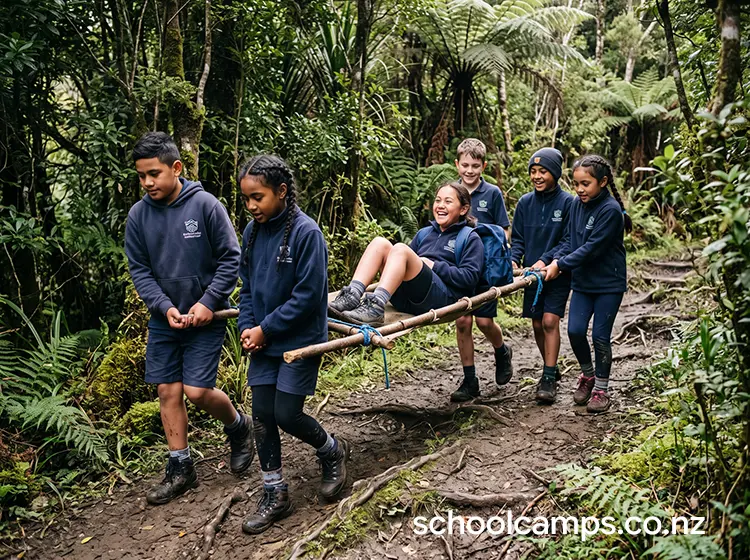
 Core Principles for School Land-Based Activities
These are the non-negotiable safety principles for land-based activities: day walks, multi-day tramping, and time spent in the New Zealand bush. These must be in place before any group heads out. For broader context, see Health & Safety Planning for School Camps. Climbing, archery and horse riding carry their own specific technical safety requirements, covered in their individual activity guides: this page is the shared foundation underneath all of them, plus the core reference for tramping and bush walks specifically.
Core Land Safety Principles
1. Match the route to the group, not the other way around
Choose tracks and routes based on your least able student, not your most capable. Check the Department of Conservation track category (Short Walk, Walking Track, Great Walk, Route) and be honest about your group’s fitness, footwear, and experience. Build in generous time margins: the goal is arriving with daylight and energy to spare, not a personal best.
2. Weather changes fast: plan for the conditions you might get, not the forecast
New Zealand weather can shift dramatically within hours, especially near ranges and coastlines. Check the forecast 24 hours out and again the morning of, but pack for conditions worse than forecast: a rain jacket and warm layers go in the pack even on a fine-looking day. Know your turnaround triggers in advance and stick to them.
3. Non-cotton layers, always
Cotton holds moisture against the skin and accelerates heat loss: it kills in the New Zealand bush more reliably than almost any other single clothing mistake. Require synthetic or merino base layers, a warm mid-layer, and a genuine waterproof shell for every student, regardless of how the day looks at the start.
4. Group cohesion is a safety system, not a courtesy
Establish a clear rule: nobody moves past a track junction or split until the whole group has regrouped there. Appoint a lead and a tail (often a teacher or the most experienced adult) and never let the group split further than sight or voice contact allows without a deliberate, planned decision to do so.
5. Rivers are a hazard in their own right
Unbridged river and stream crossings cause a disproportionate share of serious incidents in the New Zealand outdoors. Treat any crossing as a discrete decision point: assess depth, flow, and an escape route before committing, and have a default rule of turning back or finding an alternative route if the crossing looks marginal, rather than pushing through.
6. Communication doesn’t rely on cell coverage
Most tramping routes in New Zealand have patchy or no mobile coverage. Carry a Personal Locator Beacon (PLB) or satellite communicator for any trip away from easy road access, know how to use it, and always leave detailed trip intentions with a contact who is not on the trip: Plan My Walk is the standard tool for this in New Zealand.
Essential Group Gear Checklist
A well-prepared group carries: map and compass (and the skill to use them: not just a phone GPS); a Personal Locator Beacon or satellite communicator; a first aid kit sized to the group and carried by a nominated, trained adult; emergency shelter (a group shelter or bivvy bags) and a headtorch per person; spare warm layers and food reserves beyond what’s needed for the planned day; and trip intentions left with a contact not on the trip, with a clear “raise the alarm by” time.
Red Flags: Turn Back or Don’t Start
Stop or change plans if: a severe weather watch or warning is current for the area, or forecast conditions exceed the group’s experience; a river or stream crossing looks discoloured, fast, or above knee-deep on the smallest student; any student shows signs of hypothermia, heat exhaustion, or is struggling well beyond the rest of the group; the group becomes separated beyond sight or voice contact; daylight margins have eroded to the point the group would finish after dark; or a required piece of safety equipment (PLB, first aid kit, map) is missing or unusable.
Weather and Decision-Making
Before the activity: check the detailed forecast 24 hours out, recheck the morning of departure, and set clear go/no-go thresholds in advance rather than deciding under pressure on the day.
During the activity: one adult holds clear decision-making authority to modify or turn back the route. Continuously reassess: New Zealand conditions can deteriorate faster than a forecast update.
Emergency Response
First aid and medical: at least one adult carries a well-stocked first aid kit and current first aid certification; know the route to the nearest road access and estimated time to help; carry accessible student medical information (allergies, conditions, medications).
Communication plan: a PLB or satellite communicator for remote sections; a clear emergency contact list (parents, school leadership, emergency services); a defined protocol for who calls whom, and when trip intentions should trigger a search if the group hasn’t checked in.
Risk Assessment Essentials
Before any land-based activity, complete a risk assessment covering:
- Hazards: what could cause harm? (terrain, river crossings, weather exposure, falls, getting lost, fatigue, sun exposure, cold)
- Risks: how likely and how serious is the harm?
- Controls: what will you do to reduce or eliminate risk? (route selection matched to ability, group management rules, weather thresholds, communication devices, adult positioning)
- Response: what’s your plan if something goes wrong? (injury response, lost-group protocol, evacuation, calling for help)
Under EOTC guidelines, multi-day tramping and other higher-risk land activities typically sit in the highest residential-activity category, meaning they need board/principal approval, activity-specific parental consent, a documented safety management plan, and evidence that the activity leader’s competence has been checked against a recognised standard: not just a generic camp risk assessment.
Additional Safety Resources
- NZ Mountain Safety Council (NZMSC): tramping, navigation and bush safety resources, and the Plan My Walk tool: mountainsafety.org.nz
- AdventureSmart: trip planning and outdoor safety codes: adventuresmart.nz
- Department of Conservation (DOC): track categories, hut and track conditions: doc.govt.nz
- Education Outdoors New Zealand (EONZ): EOTC Safety Management Plan and Toolkit: eonz.org.nz
- NZ Outdoor Instructors Association (NZOIA): qualification standards for outdoor instructors: nzoia.org.nz
What a Safe Land-Based Session Looks Like
You’ll know safety is in place when: the route matches the least able student in the group, not the most capable; every student has proper non-cotton layers and correct footwear; the group has stayed together at every junction and split point; the weather has been checked twice and thresholds are agreed in advance; a PLB or satellite communicator is carried and trip intentions have been left with someone not on the trip; and everyone (students included) knows the plan if someone is hurt or the group needs to turn back.
These safety principles are the non-negotiable baseline for any school land-based activity. When properly implemented, they allow students to challenge themselves in New Zealand’s outdoors in an environment where risk is managed, not eliminated.
Related Resources
For a template to build your own written safety plan around these principles, see our free RAMS Safety Management Plan template.
Leave a Reply
You must be logged in to post a comment.