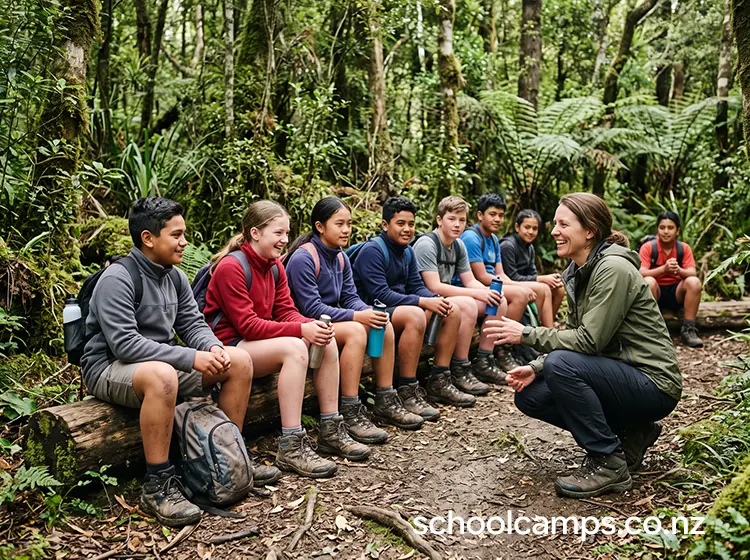
 Reflection is where the real learning happens. Without it, outdoor activities (whether paddling, climbing, tramping, archery or horse riding) stay as “fun things we did” rather than experiences that stick and grow. This guide provides practical frameworks for facilitating meaningful debriefs after any outdoor activity.
Why Debriefing Matters
Taking time to reflect helps students process what happened and lock in the learning, identify strategies that worked (and can be used in other situations), understand how they learn and what helps them succeed, connect outdoor experiences to curriculum learning, name their challenges and successes, and build confidence for future challenges.
Quick Debrief Format (5–10 Minutes)
Use this four-question structure immediately after the activity:
- What happened? (Factual recap) Students describe what they did, where they went, what they noticed. Keep this brief: just establishing shared experience. Example prompts: “Where did we go? What did you see along the way? What was the [water/track/climb] like?”
- What was hard? (Acknowledge challenges) Name the difficulties: technique, tiredness, fear, communication breakdown, weather. Normalise struggle as part of learning. Example prompts: “What did you find challenging? When did you feel frustrated or tired? What surprised you about the difficulty?”
- What helped? (Identify success strategies) This is the key question. Draw out specific strategies: partner encouragement, taking breaks, trying a different technique, asking for help. Example prompts: “What did you do when things got tough? Who or what helped you keep going? What did your partner do that made a difference?”
- What will we take forward? (Transfer learning) Help students see how today’s learning applies beyond the activity itself. Connect to broader life skills. Example prompts: “This problem-solving approach could help you in… When else in life do we need to stay calm under pressure? What did you learn about yourself today?”
Facilitation Tips
Keep it conversational, not a formal presentation. Use a talking stone or paddle to manage turn-taking. Normalise struggle: “Lots of you mentioned steering was hard. That’s because it IS hard when you’re learning, and you all kept trying anyway.” Connect observations to broader themes: “Several of you said what helped was clear communication with your partner. Where else in life is clear communication essential?” Invite specific examples: “Can someone give me an example of a moment where you had to problem-solve?” End on celebration: acknowledge growth and effort, even for students who struggled.
Optional Written Reflection (3–5 Minutes)
For teachers who want written reflection, keep it very short. These prompts work well:
- One thing that surprised me about [activity] today was…
- The best moment was… because…
- Something my partner did that helped our team succeed:
- A skill I developed today that I didn’t have this morning:
- Next time I face something difficult, I’ll remember…
Links to Curriculum Themes
Make connections explicit for students. For detailed curriculum links, see NZ Curriculum Online.
Health & PE / Hauora: personal identity and mana (trying new things builds confidence), interpersonal skills (partner communication), outdoor education competencies, risk assessment.
Science / Pūtaiao: forces and motion (paddle strokes, climbing forces on an anchor, an arrow’s trajectory), water cycle and ecosystems, geology and landforms on a tramping track, environmental observation, impact of weather on conditions.
Social Sciences: connection to place (local waterways, forests, and land: ecological health, cultural significance), sustainable use of natural resources, environmental stewardship.
Key Competencies: thinking (problem-solving technique, decision-making about routes or lines); relating to others (partner communication, group navigation, belaying trust); managing self (persistence, self-regulation, resilience); participating and contributing (teamwork, leadership); using language, symbols and texts (interpreting weather, reading a map or a route).
Deeper Debrief for Longer Activities
For full-day or multi-day experiences, use this extended framework:
Rose, Thorn, Bud: Rose; a highlight or success moment. Thorn: a challenge or difficulty. Bud: something you’re looking forward to or want to develop further.
Circle of Viewpoints: students share from different perspectives: “As a paddler, I think… As a team member, I noticed… As someone who was nervous, I felt…”
Sentence starters for deeper reflection: I used to think… Now I think… I discovered that I… A connection I made was… Something that changed for me was…
These thinking routines are adapted from Harvard’s Project Zero.
Common Debrief Pitfalls to Avoid
Making it too long (exhausted students can’t engage in 30-minute processing sessions: keep it focused); skipping it because you’re tired (a brief debrief is better than none: even 5 minutes locks in learning); asking leading questions (“Didn’t you love how beautiful the lake was?”: let students identify their own meaning); only focusing on positives (honest processing of challenges is where growth happens); letting a few voices dominate (use structures that ensure all students contribute).
Follow-Up Activities Back at School
Extend learning beyond the immediate debrief: photo review and storytelling; a letter to future students going on camp (“Here’s what I wish I’d known…”); goal setting for the next outdoor experience; thank-you letters to instructors or venue; skills practice in PE to maintain momentum.
Remember: the debrief isn’t an add-on. It’s where the learning happens. Build it into your planning as an essential part of the activity, not something you do if there’s time.
Leave a Reply
You must be logged in to post a comment.