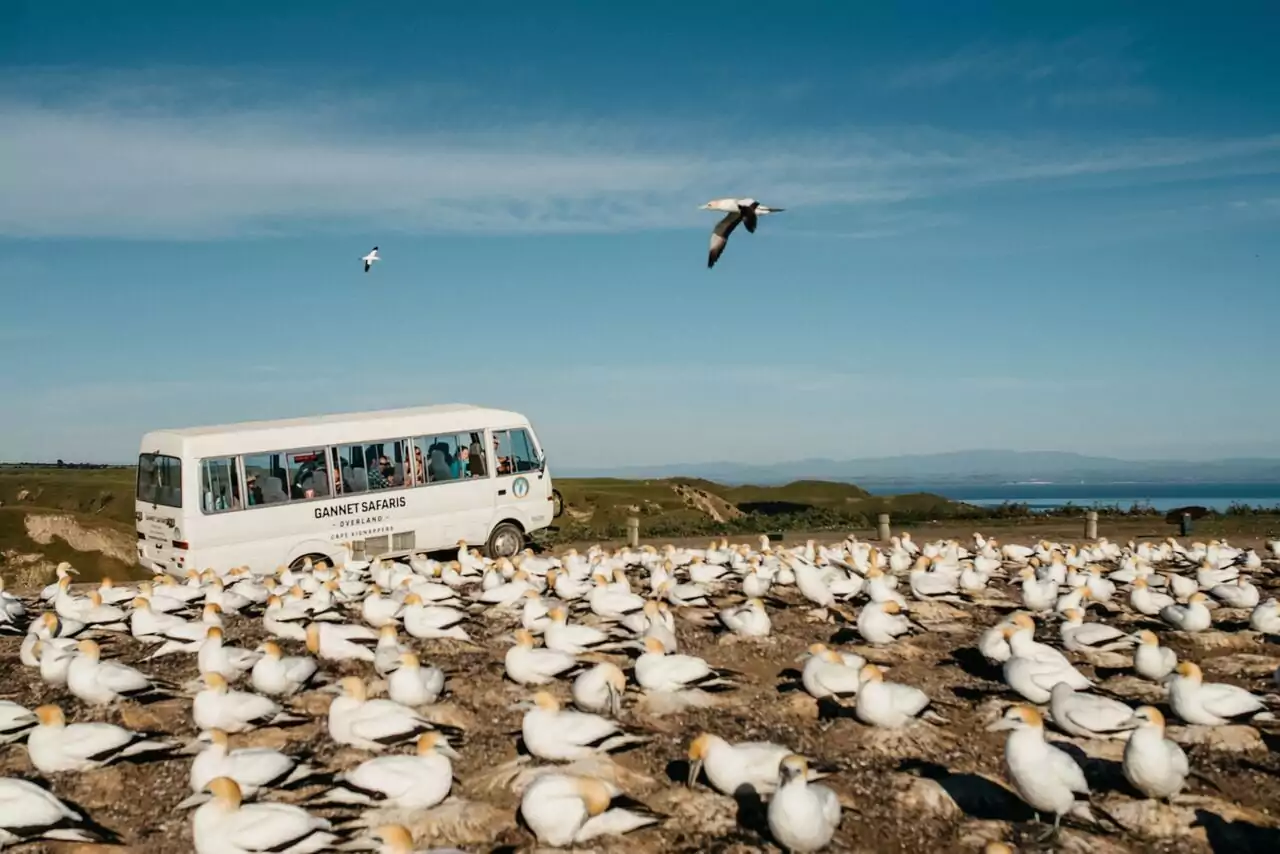
Gannet Safaris Overland runs guided 4×4 tours from Te Awanga in Hawke’s Bay, across Cape Kidnappers Station to the cliff-top gannet colony at Cape Kidnappers, one of the largest and most accessible mainland gannet colonies in the world. For a Hawke’s Bay school trip it offers custom educational tours for students of all ages, taking up to 100 students and caregivers per trip and bringing them within a few metres of the nesting birds with no walking needed.
Why schools choose Gannet Safaris
- Close to the colony: students view thousands of nesting takapu (Australasian gannets) from a cliff-top lookout above the gannet plateau.
- No walking required: everything can be seen from the vehicle, and the plateau is flat with bench seats.
- Tailored to your class: tours can focus on local history, Māori legends and knowledge, geology, wildlife conservation and the gannets themselves.
- Whole-group capacity: up to 100 students and caregivers per trip, in vehicles seating 21 each.
- Paperwork sorted: RAMS and supporting documents are provided to schools on booking.
- Not affected by tides: the overland route runs above the cliff tops, unlike the beach approach.
- Over 50 years’ experience: Gannet Safaris has been running overland tours to the colony for more than half a century.
School programmes and activities
School educational tour
A custom tour for school groups of any age. Students travel in air-conditioned 4×4 vehicles from the Te Awanga base across coastal pasture, native bush, riverbeds and steep gullies on Cape Kidnappers Station, a working farm, before reaching the lookout over the gannet plateau, about 100 metres above the Pacific Ocean. Guides talk about local Māori legends, conservation, geology, farming and the ecology of the cape along the way. The standard overland tour covers 36 km and takes about three hours.
Beach stop at the DOC hut
After the plateau, school groups can stop at the DOC hut and walk the track down to the beach for morning or afternoon tea. This depends on the tide and adds about 1 to 1.5 hours.
Other tour formats
Gannet Safaris also runs regular public tours, early-morning sunrise tours, private tours, cruise ship shore excursions and a longer Ultimate Day Out, which may suit smaller groups or staff.
Learning opportunities
The cape is a living classroom for seabird biology. The colony has around 20,000 birds and a nesting history going back to the 1870s. Gannets usually start breeding at four or five years old, pairs can stay together for decades, and young birds make their first flight across the Tasman to Australia, spending several years there before returning to breed. The tour also passes through farmland and the area protected by The Cape Sanctuary, a large privately owned wildlife sanctuary that Gannet Safaris supports.
Curriculum connections
A visit fits well with education outside the classroom (EOTC) and can support learning in:
- Science: seabird life cycles, migration, feeding and diving, coastal ecology, geology of the cliffs and predator-free conservation.
- Social Sciences: local history, farming on Cape Kidnappers Station and the story of conservation on the peninsula.
- Te ao Māori: local Māori legends and indigenous knowledge of the area, including the takapu.
- Education for sustainability: how private landowners, volunteers and tourism operators work together to protect native species.
- Key competencies: thinking, and participating and contributing, through guided observation and discussion.
Safety and instruction
All tours are led by experienced guides who drive the vehicles and give commentary throughout. RAMS and other documentation are provided to schools when they book. Students need to be able to get on and off the vehicle without help. There are no toilets on the tour, so plan a stop at the base before departure, where facilities are good.
What to bring
- Morning or afternoon tea, or lunch, for each student.
- A named drink bottle.
- Cameras are welcome, but drones are not allowed.
Tea and coffee are provided for adults.
Adding Gannet Safaris to a school camp
The Te Awanga base is about 25 minutes from Napier, Hastings and Havelock North, so a gannet tour fits easily into a Hawke’s Bay school camp based anywhere around Heretaunga or Ahuriri. A morning or afternoon departure leaves the rest of the day free for another activity, or groups can add the beach stop and make it a half-day outing. It pairs well with a visit to the National Aquarium in Napier or a climb of Te Mata Peak.
About Gannet Safaris Overland
Gannet Safaris Overland Ltd has been guiding visitors over the land at Cape Kidnappers for more than 50 years, and is the only operator offering overland tours to the colony. Since September 2022 it has donated part of every booking to The Cape Sanctuary, which has a 10.6 km predator-proof fence across the peninsula, has planted over 1.5 million native trees and has reintroduced 18 species, including kiwi, petrels and Cook Strait giant wētā. The company follows environmental policies covering waste, energy, single-use plastic and fleet emissions, and checks vehicles for hitchhiking predators before entering the reserve.
School group rates
School tours are priced on enquiry and depend on the group and the programme. For public tours there are adult and child fares, with children aged 5 to 17 at half the adult fare, and tours are prepaid. Cancellations within 48 hours of the tour are not refunded. Contact Gannet Safaris Overland for current rates.
Example school visit
An example of how a school visit to Gannet Safaris could look (every visit is planned with the provider):
- Arrival: meet at the Te Awanga base, toilet stop and safety briefing.
- Coast and farm: drive across Cape Kidnappers Station through pasture, bush, riverbeds and gullies, with commentary on geology, farming and Māori legends.
- Gannet plateau: time at the cliff-top lookout watching the colony, with a guide talk tailored to the class.
- Beach stop (tide permitting): walk from the DOC hut to the beach for morning or afternoon tea.
- Return: drive back to Te Awanga.
Getting there
Tours leave from the Gannet Safaris base at Te Awanga, on the coast road south of Clifton, about 25 minutes’ drive from Napier, Hastings and Havelock North. There’s a large off-road car park with room for several motorhomes. Public access to the colony overland is across private land, so the cape can’t be reached by vehicle independently.
Nearby attractions for school groups
- Te Awanga and Haumoana beaches: the coastline right beside the base.
- Hawke’s Bay Trails: flat coastal cycle paths linking Clifton, Te Awanga, Haumoana and Napier.
- Te Mata Peak: walking tracks and wide views over Heretaunga, near Havelock North.
- National Aquarium of New Zealand: marine life and education programmes on Marine Parade, Napier.
- MTG Hawke’s Bay: Napier’s museum, theatre and gallery, including the 1931 earthquake story.
- Napier Art Deco precinct: the city rebuilt after the 1931 earthquake.
Other groups and events
- Public tours: morning and afternoon departures through the season.
- Sunrise tours: private early starts, popular with photographers.
- Private tours and the Ultimate Day Out.
- Cruise ship shore excursions from Napier.
- Gift vouchers.
Good to know
- The tour season runs from early September to late April, during the gannet breeding season.
- Each vehicle seats 21, with up to 100 students and caregivers per trip.
- Students need to board and leave the vehicle unaided. Little or no walking is involved unless the beach stop is added.
- There are no toilets on the tour.
- Children must be accompanied by an adult.
- Drones and dogs are not permitted, as the route crosses a wildlife sanctuary.
- Tours may be cancelled by the operator for events beyond its control, with payment refunded.
Frequently asked questions
How many students can go on one trip?
Up to 100 students and caregivers per trip, in vehicles that seat 21 each.
Do students have to walk far?
No. The colony can be seen from the vehicle and the plateau is flat with bench seats. The optional beach stop at the DOC hut involves a short walk.
Can the tour be tailored to our curriculum?
Yes. School tours can focus on local history, Māori legends and knowledge, geology, wildlife conservation or the gannets.
When is the tour season?
From early September to late April.
Is food provided?
Students bring their own morning or afternoon tea or lunch and a drink bottle. Tea and coffee are provided for adults.
Are safety documents available?
Yes. RAMS and other documentation are provided to schools on booking.
How long does the tour take?
The overland tour takes about three hours. The tide-dependent beach stop adds about 1 to 1.5 hours.
Where do tours leave from?
From the Gannet Safaris base at Te Awanga, about 25 minutes from Napier, Hastings and Havelock North.