This reference guide provides short, practical activities for use in the 2–3 weeks leading up to camp. These activities prepare students physically, mentally, and socially for water activities, improving confidence and learning outcomes.
Why Preparation Matters
Students don’t need to be athletes, but a bit of preparation makes a big difference:
- Builds physical readiness (endurance for sustained paddling)
- Reduces anxiety through familiarity with movements and expectations
- Develops partner communication skills before pressure of on-water environment
- Increases safety by practising balance and coordination
- Builds excitement and reduces fear of the unknown
Fitness Activities (10–15 minutes, 2–3 times)
Upper body circuits
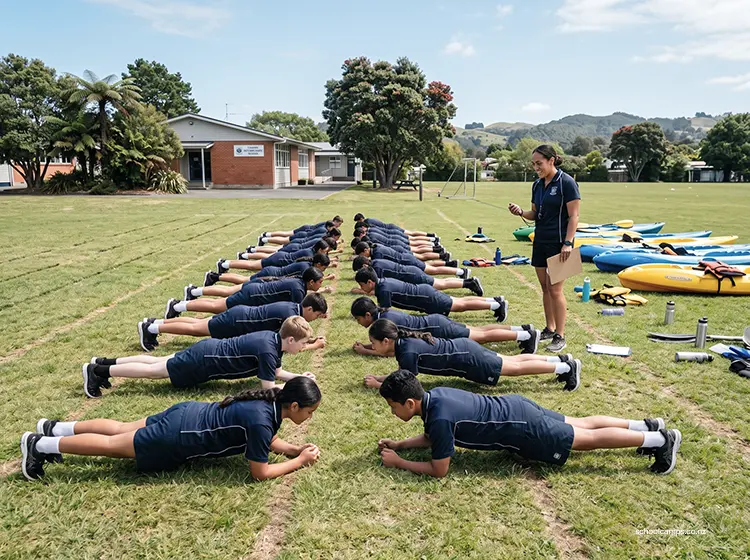
In PE class, rotate through stations: wall push-ups (30 seconds), plank hold (30 seconds), resistance band pulls simulating paddle strokes (30 seconds), shoulder taps in plank position (30 seconds). Repeat circuit 3 times. Focus on building endurance, not strength.
Sustained movement practice
Rowing machine if available (5–10 minutes at moderate pace); swimming laps focusing on steady rhythm rather than speed; sustained star jumps or jogging in place (3–5 minutes). The goal is building cardiovascular endurance for sustained paddling effort.
Core rotation practice
In PE or classroom: practice twisting from the core (not just arms) to simulate paddle strokes; seated twist exercises with medicine ball or imaginary paddle; standing rotation exercises reaching side to side.
Skill Practices (5–10 minutes in classroom or outdoors)
Paddle stroke simulation
Using broomsticks or similar props: demonstrate the three-part stroke (reach forward: rotation from core; pull through; blade vertical; recover: feather paddle back). Students practice in pairs, giving each other feedback. Practice both sides to develop balanced technique.
Balance challenges
Set up low balance beams or tape lines on the floor: walk heel-to-toe along the line, turn 180 degrees mid-beam, stand on one foot while a partner tosses a ball. Links directly to stability awareness needed in canoes/kayaks.
Confidence and Teamwork Activities
Partner trust walk
In pairs, one student blindfolded while partner gives clear verbal directions to navigate an obstacle course. Switch roles. Debrief: “What made good instructions? How did it feel to trust/be trusted?” Direct parallel to paddling communication.
Synchronised movement
Pairs stand side-by-side and attempt to walk in perfect sync, matching stride length and timing. Increase difficulty: walk backward, turn corners, speed up. Reinforces coordination needed for tandem paddling.
Water safety discussion
Circle discussion or short video about staying calm in water, what PFDs do and why we wear them, and why we don’t panic if we capsize. Normalise that getting wet is okay and part of learning.
Build excitement
Show short videos of paddling (ideally at your planned venue or similar NZ locations); invite past students to share their experiences; read aloud a story about water adventures. Reduces anxiety through familiarity and builds positive anticipation.
Partner Communication Practice
Practice giving clear, calm instructions in pairs during any class activity. This transfers directly to on-water communication.
Examples: one partner guides the other through drawing a shape without looking at the paper; giving directions to navigate around the classroom using only verbal cues; describing an image that a partner must recreate without seeing it.
Debrief: What makes instructions clear? How do you adjust when a partner doesn’t understand? These skills apply directly to coordinating paddle strokes.
Mental Preparation
Addressing fears
Have an open discussion about common concerns: fear of deep water, worry about capsizing, concern about looking silly or failing, anxiety about being cold or wet. Normalise these feelings and explain the safety measures in place. Let students know it’s okay to be nervous and that adults will support them.
Visualisation exercise
Guide students through a brief visualisation (3–5 minutes):
“Close your eyes. Imagine yourself arriving at the water. You’re wearing your PFD. You step into the canoe/kayak/SUP with your partner. It feels stable. You pick up your paddle. The water is calm. You take your first stroke. The paddle pulls through the water smoothly. You and your partner are working together. You’re moving forward. You feel confident and capable.”
Timeline for Preparation
- 3 weeks before: Start fitness activities (2–3 sessions per week)
- 2 weeks before: Add skill practices and partner communication exercises
- 1 week before: Focus on confidence building, address fears, build excitement
- Days before: Final reminder about what to bring, brief visualisation exercise
Expected Outcomes
When students arrive at camp having completed these preparation activities:
- They have better physical endurance for sustained paddling
- They feel less anxious because movements and expectations are familiar
- Partner communication is already practised and more effective
- They’re excited rather than fearful about the experience
- Instructors can focus on advanced skills rather than basic confidence building
- Safety is improved through better balance, coordination, and awareness
These activities take minimal class time but make a real difference. Students arrive at camp more confident, better prepared, and ready to get the most out of the experience.
Related Resources
For more on building water confidence and managing student behaviour outdoors, see:
Behaviour Management Outdoors (strategies for partner communication and group dynamics)
Water Safety New Zealand resources: watersafety.org.nz
Leave a Reply
You must be logged in to post a comment.