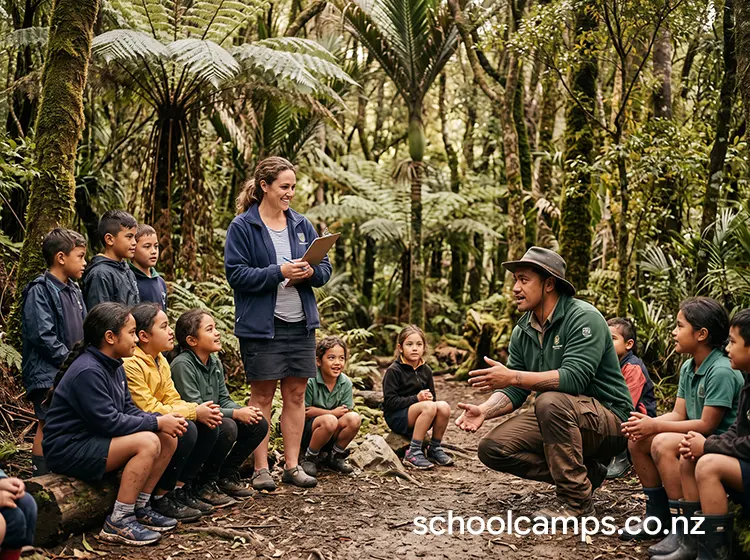
 This guide helps teachers decide when to use external providers (for paddling, climbing, tramping, archery, horse riding, and other outdoor activities) and how to select high-quality providers that align with your school’s safety and learning standards.
When to Use a Provider vs Teacher-Led
Provider-Led Works Best When:
- Teachers lack the specific technical qualification the activity requires (water safety and paddling expertise for canoeing/kayaking/SUP; an NZOIA rock or climbing wall qualification for climbing; a qualified instructor for horse riding)
- Equipment needs are beyond school resources (canoes, kayaks, SUPs and PFDs for water; harnesses, ropes and helmets for climbing; horses, tack and archery equipment for those activities)
- The venue is unfamiliar or conditions could be variable
- Insurance or organisational policy requires external providers for the activity, which is common for climbing, horse riding, and multi-day tramping/expeditions
- Schools want specialist instruction and progression frameworks beyond basic introduction
Teacher-Led Works Best When:
- Teachers hold current, relevant qualifications for the specific activity (water safety and paddling for water activities; tramping leadership experience and navigation skill for day walks; a current archery coaching accreditation for archery)
- The school owns or has access to appropriate equipment and safety gear
- The venue is very familiar and well within the group’s ability (a school pool or known lake for water activities; a well-marked local track for a day walk; a school field for archery)
- Budget is limited and staff capability is high
- The session is part of ongoing skill development where teachers maintain continuity
Questions to Ask When Selecting a Provider
Use these questions when evaluating providers to ensure they meet your school’s standards for safety, pedagogy, and student care.
- What qualifications and experience do instructors hold for this activity?
For water activities, look for current water safety qualifications (minimum Deepwater Lifeguard or equivalent) and paddling instructor certification through NZOIA or Paddle NZ. For climbing, ask for a current NZOIA Rock or Climbing Wall qualification appropriate to the venue and style of climbing. For tramping or expeditions, ask for a relevant NZOIA Bush or Mountain qualification, or demonstrated leadership experience on similar terrain. For every activity, confirm current first aid certification and experience working with your age group.
- How do you manage weather calls and cancellations?
Understand their thresholds for wind speed, lightning, temperature and visibility: this applies as much to a tramping trip or an outdoor climbing day as it does to water activities. Ask about their cancellation/postponement policy and whether fees are refunded, credited, or rescheduled. Clarify who makes the final decision and how you’ll be notified.
- What student-to-instructor ratios do you use, and what do you need from teachers?
Ask for the ratio they’ll run and how it was set: EOTC guidance treats ratios as risk-based rather than fixed, so a good provider will explain how the venue, conditions and group experience shaped their number rather than quoting one figure for everything. As a rough guide, expect something in the range of 1:8–1:10 for lower-risk activities like flatwater paddling or a well-marked day walk, tightening to 1:6 or lower for moving water, outdoor lead climbing, or overnight tramping. Clarify what teachers are expected to do: supervise from shore or trail, manage medical needs, or lead debriefs.
- How do you cater for nervous students or additional needs?
Listen for willingness to adapt activities, experience with anxious or neurodivergent students, options for graduated participation, and a non-punitive approach to refusal or fear. Ask for specific examples of how they’ve supported diverse learners.
- What gear is provided, and what do students bring?
Confirm what technical gear is included: craft, paddles and PFDs for water activities; harnesses, ropes, helmets and climbing shoes for climbing; helmets, hard hats and appropriate footwear rules for horse riding; bows and safety equipment for archery. Clarify what students must bring themselves (clothing, footwear, water bottles, personal items) and whether specialised gear like wetsuits is available if needed.
- What is your emergency plan and communications setup?
Ask about: emergency communication devices (radios, phones, PLBs), evacuation procedures, nearest medical facilities and estimated response times, how parents are contacted in event of incident, and staff first aid capabilities.
- How do you structure learning outcomes and debriefs?
Assess whether provider sees this as “just a fun activity” or an intentional learning experience. Ask them to describe specific skills students will develop, how they facilitate reflection, and how the activity connects to curriculum. Ask if teachers are involved in debriefing.
What Teachers Should Still Do (Even When a Provider Is Involved)
Even with a qualified external provider leading the activity, teachers maintain critical responsibilities:
- Know the full session plan, route, and timings before the activity begins
- Confirm student-to-instructor ratios meet your school’s requirements and EOTC guidelines
- Manage student medications and be prepared for medical response if needed
- Set and reinforce behaviour expectations before and during the session
- Maintain the learning focus: why are we doing this? What are students noticing and learning?
- Lead or co-facilitate the debrief to lock in learning outcomes and connect to curriculum
- Monitor students who may need extra support or modified participation
Hybrid Approach: Getting the Best of Both
Many schools find success with providers leading technical instruction and on-site safety while teachers manage group dynamics, behaviour expectations, and learning reflection. For example:
- On the water, a provider runs the safety briefing, teaches paddling technique, monitors conditions, and handles emergencies, while teachers know student medical needs, facilitate partner selection, and lead debriefs
- On a climbing wall or crag, a provider sets up and checks all technical systems (ropes, harnesses, anchors) and belays or supervises belaying, while teachers manage the queue, encourage nervous students, and reinforce behaviour expectations at the base
- On a multi-day tramp, a provider or qualified leader makes the technical calls on route, pace and weather, while teachers manage group welfare, morale, and the evening debrief
This division of responsibilities ensures specialist safety expertise while maintaining the teacher-student relationship and learning continuity.
Red Flags When Evaluating Providers
Be cautious if a provider:
- Cannot provide evidence of instructor qualifications or insurance
- Suggests ratios higher than industry standards without clear justification
- Has no clear weather cancellation policy or seems dismissive of weather concerns
- Cannot articulate specific emergency procedures or communication systems
- Focuses only on “fun” without discussing learning outcomes or reflection
- Has negative reviews from other schools (check references!)
Related Resources
For comprehensive health and safety planning guidance for school camps, see:
Health & Safety Planning for School Camps
EONZ Safety Management Plan and Toolkit: eonz.org.nz
Water Safety New Zealand school guidelines: watersafety.org.nz
NZ Mountain Safety Council, for tramping and bush safety guidance: mountainsafety.org.nz
NZOIA, for the full range of outdoor instructor qualifications across climbing, tramping and other land-based disciplines: nzoia.org.nz
Curious what providers themselves are told to prepare for these same questions? See our companion piece, What Schools Ask Before Booking You.
Leave a Reply
You must be logged in to post a comment.