 This guide covers activity-specific elements of archery. For broader topics that apply across land-based activities, see our standalone reference guides:
- Working with Outdoor Education Providers
- Parent Communication for Land-Based Activities
- Student Preparation for Land-Based Activities
- Behaviour Management Outdoors
- How to Debrief Outdoor Experiences
- Land and Bush Safety Foundations
1. Quick Overview
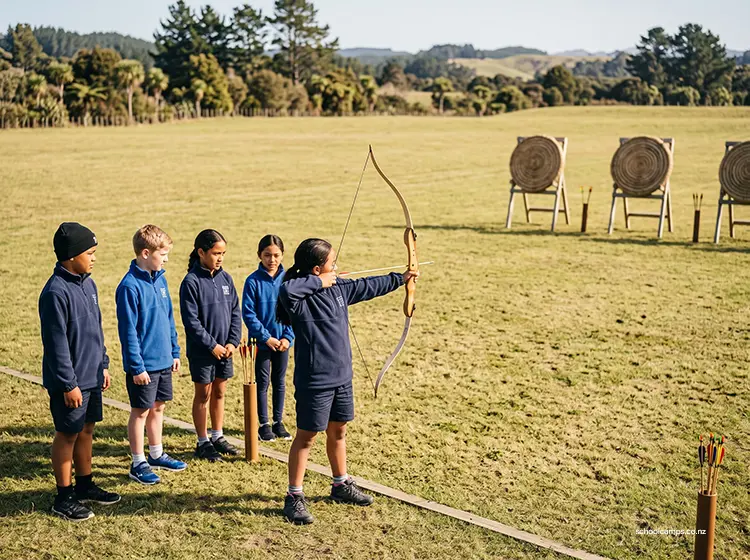
Archery introduces students to safe bow handling and shooting technique on a supervised range, most often at a school field, camp venue, or dedicated archery club. Students shoot at fixed target faces from a set distance, under close instructor supervision and strict range rules that are non-negotiable from the very first session.
Unlike many outdoor activities, the physical risk in archery is almost entirely managed through discipline and rules rather than protective equipment: there’s no harness or PFD doing the safety work, which means behaviour management and rule compliance are the central safety concern from the outset. Done well, it’s calm, focused, and surprisingly meditative; students often describe it as one of the more unexpectedly enjoyable activities at camp.
Schools choose it because it requires relatively little space and equipment, suits a wide age range, builds genuine focus and self-regulation, and gives quieter or less physically confident students a chance to excel in a way that team sports or high-adrenaline activities sometimes don’t.
Typical duration options
- Taster session (45–60 minutes): range safety briefing, basic technique instruction, supervised shooting at close range. Good as one station in a rotation day.
- Half-day session (2–3 hours): full technique progression, scored shooting rounds, simple competition format.
- Full-day session (with Archery NZ School Shoot Programme): a structured 36-arrow scored round at 15 metres, following Archery NZ’s School Shoot Programme format, allowing results to count toward a national schools competition.
2. Learning Outcomes Teachers Can Actually Use
Personal skills: builds focus and self-regulation (archery rewards a calm, controlled state, and quickly shows students the cost of frustration or rushing); develops persistence through a skill that improves gradually with repetition; manages the disappointment of a poor shot and resets for the next one; takes positive pride in precision and control rather than raw physical output.
Social skills: follows shared safety rules as a group, reinforcing that everyone’s safety depends on everyone’s discipline; offers specific, technical encouragement to peers; waits turns patiently in a structured rotation; supports teammates in simple team-scoring formats.
Outdoor/technical skills: develops correct bow-handling technique (stance, grip, draw, anchor, release); understands and correctly follows range commands and safety rules; learns basic equipment care.
Thinking skills: problem-solves technique adjustments based on where arrows land; makes small, deliberate adjustments and observes the result; develops concentration and the ability to reset focus after a mistake.
Wellbeing: experiences a genuine sense of mastery through visible, measurable improvement; builds calm and mindfulness through a repetitive, focused physical skill; gives quieter students a low-adrenaline activity where they can genuinely shine.
3. Best Year Levels and Group Sizes
Suggested year levels
- Year 4–6 (Intermediate, per Archery NZ’s age bands): shorter draw-weight bows, close shooting distances, and a strong emphasis on rules and discipline before technique refinement.
- Year 7–8: standard equipment for the age group, introduction of scored rounds, and simple technique coaching.
- Year 9–13 (Secondary, per Archery NZ): full technique progression, genuine competitive scoring, and (where a school wants to build ongoing capability) entry into Archery NZ’s School Shoot Programme.
Group size guidance
- Whole class (25–30 students): works well as a rotation activity, since only a handful of students can safely shoot at once: pair the archery range with a second activity to keep everyone engaged while waiting.
- Small groups (8–12 students): ideal for a dedicated archery session with good instructor attention.
- Very large groups (60+): only feasible with multiple ranges/lanes running simultaneously, or a staggered rotation through the day.
Ratios and supervision
Archery ratios are driven by range safety, not general supervision norms: expect roughly 1:6–1:10 shooters per qualified range officer or coach, with the range officer’s full attention on the shooting line at all times: this isn’t a role that can be combined with other supervision duties. A teacher-in-charge or senior club member must officiate for any results to count toward Archery NZ’s postal competitions.
4. Working with Providers
Deciding whether to run teacher-led or provider-led sessions, questions to ask providers, and what teachers should still do when working with external instructors:
See: Working with Outdoor Education Providers
For a school wanting to run archery regularly rather than as a one-off camp activity, Archery NZ’s School and Tertiary Archery programme is worth investigating directly: it provides a structured pathway, equipment guidance, and a national competition format your students can participate in from school.
5. Planning Checklist
Permissions and communications
For parent letter templates, consent requirements, and addressing common parent concerns, see Parent Communication for Land-Based Activities.
Skills and fitness preparation
For pre-camp confidence-building and equipment-safety discussion, see Student Preparation for Land-Based Activities.
Gear and clothing
What’s provided (typical provider/venue setup): bows sized to the student (draw weight and length matched to age and strength), arrows, target faces and stands, arm guards, and finger tabs or release aids.
What students bring: closefitting tops with no loose or hanging sleeves (a loose sleeve can catch the bowstring painfully); hair tied back; enclosed shoes.
Weather management: light rain is manageable for archery, but wind significantly affects arrow flight and can make sessions frustrating or unfair for scoring: have a plan to move indoors or pause if wind picks up.
Accessibility and inclusion
Confidence levels: let nervous students start very close to the target with a lighter bow, building distance and draw weight gradually; pair students for encouragement rather than direct competition early on.
Neurodiversity: clear, consistent range commands used every time, with visual cues (flags, coloured markers) alongside verbal ones; a predictable rotation structure helps students who rely on routine; allow noise-reducing headphones if a busy range is overwhelming.
Physical needs: lighter draw-weight bows and adjustable stands accommodate a wide range of strength levels; left- and right-handed equipment should both be available; consult a provider in advance for students with specific mobility needs: archery is genuinely one of the more physically accessible outdoor activities available.
Keeping everyone involved: rotate roles (scorer, arrow-collector under supervision, encourager); simple team-scoring formats let students of different skill levels contribute meaningfully; celebrate improvement over the session, not just raw scores.
6. Safety, Risk, and Good Practice
Hazards to think about: arrows leaving the designated shooting lane (through poor technique, distraction, or horseplay); people crossing the shooting line while others are shooting; equipment misuse (drawing a bow without an arrow, pointing a bow at a person even in play); arrows retrieved before the range is declared safe; wind affecting arrow flight and landing point.
Key controls: a comprehensive briefing on range commands before anyone picks up a bow, with a clear demonstration and a check that students can repeat the commands back; a strict rule that arrows are only nocked and drawn when standing at the shooting line, facing the target, on command; a clear, loud “stop” command that immediately halts all shooting and drawing; nobody retrieves arrows until the range officer gives the explicit all-clear; equipment stored safely and out of reach when not actively supervised.
Roles on the day: a designated range officer with full authority to stop the session at any point, whose sole job during shooting is watching the line: not scoring, coaching, or managing the queue simultaneously; a scorer or recorder if running a formal round; a first aid carrier with a comprehensive kit; a queue manager keeping waiting students organised and safely back from the shooting line.
When to stop or switch plans (red flags)
Stop immediately if: any student points a bow (loaded or not) at a person; a student nocks or draws an arrow outside of the shooting command; anyone crosses the shooting line while archers are active; wind becomes strong enough that arrows are landing well outside the target area; a student is behaving in a way that suggests they can’t be trusted with the equipment.
Switch to Plan B if: conditions are marginal (light rain, moderate wind): shorten distances or pause between gusts; a student is struggling with the draw weight (move them to a lighter bow rather than persisting); the group is too large for safe supervision on one range (split into smaller rotating groups).
What a safe session looks like
- ✓ Every student can correctly repeat back the range commands before shooting begins
- ✓ Bows are only drawn on command, at the shooting line, facing the target
- ✓ A dedicated range officer is watching the line at all times during shooting
- ✓ Nobody crosses the line or retrieves arrows without an explicit all-clear
- ✓ Waiting students are positioned safely back from the shooting line
- ✓ Equipment is stored securely whenever the range isn’t actively supervised
7. Site Selection and Conditions
What makes a location suitable: a flat, open area with clear sightlines and enough depth behind the targets to safely contain overshot arrows (a natural backstop like a bank or a purpose-built safety net); enough width to space multiple shooting lanes if running several students at once; no public thoroughfare crossing the shooting line or landing zone.
Deal-breakers: any range where the area behind the targets isn’t secured (a path, road, or public area within arrow range); persistent strong wind on the day; insufficient distance between the shooting line and any spectator or waiting area.
Travel time and logistics: archery needs comparatively little travel if run at the school or camp site itself, since it requires only a flat field rather than a specialised natural feature: a real cost and logistics advantage over many other activities.
Toilets, shelter, water access: whatever is available at the school or camp site is usually sufficient; shade for waiting students is worth arranging on hot days.
“Plan B” locations: a shorter indoor range if the venue has one; if wind or rain make outdoor shooting unsafe or unfair, reschedule rather than persist with poor conditions.
8. Session Structure Teachers Can Follow
This run-sheet works for a half-day session: adjust timing for tasters or a full scored round.
1. Arrival and set-up (15 minutes): headcount; range set-up and safety check; equipment laid out and inspected.
2. Briefing (15–20 minutes): range commands taught and practised (students repeat them back); safety rules explained explicitly (never point a bow at a person, only draw on command, wait for the all-clear); equipment handling demonstrated.
3. Warm-up (10 minutes): dry-fire practice (drawing and anchoring without an arrow) to build correct form before live shooting begins.
4. Skill build (30–45 minutes): close-range shooting with instructor feedback on stance, grip, draw, anchor, and release; gradual increase in distance as technique solidifies.
5. Main challenge (45–90 minutes): choose one; scored rounds (a formal round following Archery NZ’s format if pursuing the School Shoot Programme); team relay (simple points-based team competition); or skill challenges (closest to centre, most consistent grouping).
6. Cool-down and pack out (10–15 minutes): final arrows retrieved on the all-clear; equipment counted and stored securely; range cleared and checked.
7. Debrief (10–15 minutes): quick circle debrief (see How to Debrief Outdoor Experiences); instructor highlights specific moments of focus and improvement; teacher connects to camp theme or curriculum focus.
9. Behaviour Management
For strategies on managing risk-takers, refusers, disengaged students, and creating positive reinforcement outdoors, see Behaviour Management Outdoors. Archery has an unusually low tolerance for rule-breaking given the equipment involved: a single clear warning followed by removal from the activity for the remainder of the session is a reasonable, non-negotiable standard for any safety rule breach, not just a repeated one.
10. Reflection and Debrief
For debrief frameworks, facilitation tips, curriculum links, and reflection techniques, see How to Debrief Outdoor Experiences.
11. Common Issues and Fixes
Technique and frustration
Issue: a student is consistently missing the target and getting frustrated. Fix: move them closer temporarily to rebuild confidence, focus feedback on one technique element at a time rather than everything at once, and reframe the goal as consistent form rather than score.
Issue: a student overdraws or strains with too heavy a bow. Fix: move them to a lighter draw weight immediately: correct equipment fit matters more than perceived “level” for both safety and enjoyment.
Rule compliance
Issue: a student jokes around by pointing an unloaded bow at a friend. Fix: immediate removal from the activity, regardless of intent: this is a zero-tolerance safety rule, and treating it lightly undermines the whole group’s safety culture.
Issue: a student steps toward the target before the all-clear. Fix: immediate verbal correction and a reminder of the rule to the whole group, since this affects everyone’s safety, not just that student’s.
Weather and equipment
Issue: wind picks up mid-session. Fix: pause shooting during gusts, shorten distances, or move indoors if a suitable space is available.
Issue: an arrow or bow is damaged. Fix: remove it from use immediately and swap in spare equipment: never let a student continue with visibly damaged gear.
Group bottlenecks
Issue: long waits between shooting turns. Fix: run a second, non-shooting station (technique practice with dry-fire, or a related activity) for students waiting their turn.
12. Activity Variations and Extensions
Easier version (confidence-building): very close shooting distance with light draw-weight bows; large, simple target faces; no scoring pressure, just consistent form practice.
Standard version: standard shooting distances for the age group with scored rounds and simple team competition.
Challenge version: the full Archery NZ School Shoot Programme format (36 arrows at 15 metres, 10-zone scoring), with results submitted to count toward the national schools competition; introduction of different bow types (barebow, recurve, compound) for students wanting to specialise.
13. Cost and Resourcing Notes
What tends to drive cost:
| Cost driver | Typical range |
|---|---|
| Qualified coach or range officer | $300–$550 per instructor per day |
| Bow and arrow hire | $8–$15 per student per session |
| Target faces and safety netting (if purchasing rather than hiring) | One-off cost, varies by scale |
| Archery NZ School Shoot Programme entry | Around $10 per archer for non-club members; free for club members |
Ways to keep it affordable: running the session on-site at school to eliminate transport costs entirely; teacher-led sessions where a staff member holds a current coaching accreditation; sharing equipment costs with a local archery club or another school.
Estimated total costs per student: on-site provider-led session, $15–$30 per student; a full School Shoot Programme round including entry fees, $20–$40 per student.
14. Next Steps for Schools
Ready to bring archery to your students? Here’s your checklist:
- Check readiness: review this guide and confirm you understand the safety requirements, supervision ratios, and logistical needs. Assess your staff capability: do you have a qualified coach, or do you need a provider?
- Confirm venue: identify a suitable flat, open space on-site with a safe backstop, or book an external range.
- Brief parents: use the template in Parent Communication for Land-Based Activities to inform families well in advance.
- Book a provider (if using external instruction): contact providers 6–12 weeks ahead of camp dates. Use the questions in Working with Outdoor Education Providers to assess suitability.
- Consider the School Shoot Programme: if your school wants to run archery as an ongoing activity rather than a one-off, register with Archery NZ directly.
Leave a Reply
You must be logged in to post a comment.