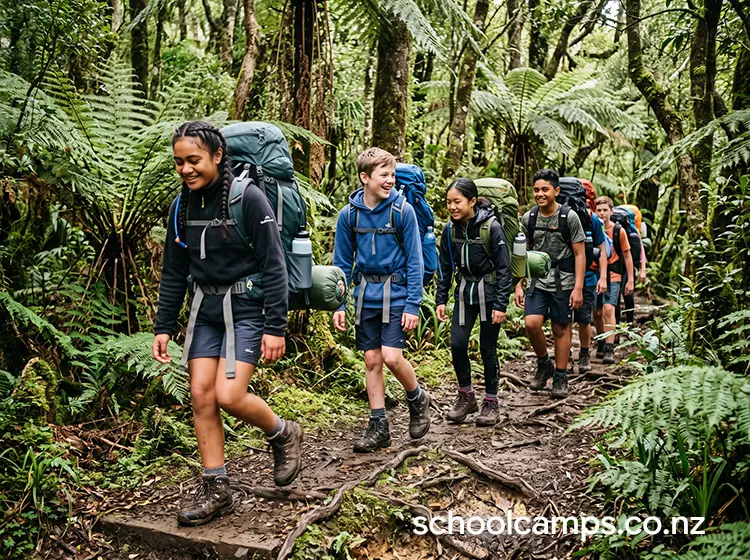
 This guide covers activity-specific elements of multi-day tramping and expeditions, including preparing for the Duke of Edinburgh’s Hillary Award. For broader topics that apply across land-based activities, see our standalone reference guides:
- Working with Outdoor Education Providers
- Parent Communication for Land-Based Activities
- Student Preparation for Land-Based Activities
- Behaviour Management Outdoors
- How to Debrief Outdoor Experiences
- Land and Bush Safety Foundations
If your students are new to walking on New Zealand tracks, start with our foundation guide: Tramping and Bush Walks, and build up to a multi-day trip once day walks are well established.
1. Quick Overview
Multi-day tramping takes the skills built on day walks and extends them into an overnight or multi-night expedition: carrying full packs, navigating longer routes, and managing group welfare over several days. In New Zealand this most often shows up as the “adventurous journey” or expedition component of the Duke of Edinburgh’s Hillary Award, which requires participants to plan, train for, and complete a supervised expedition: a 2-day, 1-night trip at Bronze level, 3 days/2 nights at Silver, and 4 days/3 nights at Gold.
Unlike a day walk, an expedition demands genuine independence: students carry their own gear, contribute to navigation and route decisions, help set up camp or a hut, and take on real responsibility for group welfare. It’s a step up in both physical demand and the level of trust placed in students, and correspondingly, in the planning and risk management required from the school.
Under EOTC guidelines, multi-day tramping sits in the highest residential-activity risk category, meaning it needs board/principal approval, activity-specific parental consent, a documented safety management plan, and evidence that the activity leader’s competence has been checked against a recognised standard (an NZOIA Bush qualification or equivalent): not just a generic camp risk assessment.
Typical duration options
- Bronze-level expedition (2 days, 1 night): a supervised but student-led trip with a qualifying assessor observing from a distance, following DofE’s practice of increasing independence at each level.
- Silver-level expedition (3 days, 2 nights): longer daily distances and more complex route-finding, with students taking on more of the leadership and decision-making.
- Gold-level expedition (4 days, 3 nights): the most demanding level, requiring sustained navigation and self-sufficiency, often in more remote terrain.
2. Learning Outcomes Teachers Can Actually Use
Personal skills: builds genuine resilience through sustained physical and mental demand over multiple days; develops self-management of energy, mood, and minor discomfort without immediate adult rescue; demonstrates persistence when tired or when plans change; takes ownership of personal gear and preparation.
Social skills: shares group responsibilities fairly (carrying shared gear, cooking, navigation); supports group members having a harder day; negotiates group decisions about pace and route; demonstrates leadership in rotating roles; manages interpersonal friction that inevitably arises over several days together.
Outdoor skills: navigates using map and compass over an extended route; sets up and breaks down camp or manages hut logistics; plans and prepares food for multiple days; manages a pack and gear system; makes weather-based decisions about route and pace.
Thinking skills: plans and adapts a multi-day itinerary against real conditions; problem-solves logistics (food, water, gear failures) without immediate adult intervention; assesses risk continuously as conditions and group energy change; reflects on decisions after the fact, a core part of the DofE assessment process.
Wellbeing: experiences significant mana through completing a genuinely challenging, sustained undertaking; builds deep connection to the New Zealand landscape; develops realistic, earned confidence in personal capability; strengthens peer relationships through shared hardship and achievement.
3. Best Year Levels and Group Sizes
Suggested year levels
- Year 9–10: appropriate starting point for Duke of Edinburgh’s Hillary Award Bronze expeditions (minimum age 14), building on a strong base of day-walk experience.
- Year 11–12: Silver-level expeditions, with genuine navigation and leadership responsibility.
- Year 13: Gold-level expeditions, the most demanding option, often planned and largely led by the students themselves within a supervised framework.
Group size guidance
DofE expeditions are typically undertaken in small groups of 4–7 students per group, each with a nominated supervisor or assessor, rather than as a whole-class activity: this is a structural requirement of the award, not just good practice, since assessment focuses on how the small group plans and executes the journey together.
Ratios and supervision
Direct supervision on a DofE expedition works differently from a day walk: assessors typically observe from a distance rather than walking with the group, to allow genuine student-led decision-making, but a qualified adult must always be within reach and have an agreed check-in system. For a general (non-DofE) multi-day school tramp, expect closer supervision: 1:6–1:8 with at least one NZOIA Bush-qualified or highly experienced leader per group, per the EOTC high-risk activity category.
4. Working with Providers
Deciding whether to run teacher-led or provider-led expeditions, questions to ask providers, and what teachers should still do when working with external instructors:
See: Working with Outdoor Education Providers
Many schools run their Duke of Edinburgh’s Hillary Award programme through Hillary Outdoors or another accredited DofE provider, particularly for training expeditions and the first supervised journey at each level.
5. Planning Checklist
Permissions and communications
For parent letter templates, consent requirements, and addressing common parent concerns, see Parent Communication for Land-Based Activities. For a multi-day expedition, consent needs to be activity-specific and cover the full itinerary, not a generic camp form.
Skills and fitness preparation
For pre-camp fitness and navigation preparation, see Student Preparation for Land-Based Activities. For an expedition specifically, students also need a proper training expedition beforehand (DofE requires this as a formal step, not an optional extra) covering pack-carrying, tent pitching, cooking, and navigation under realistic conditions.
Gear and clothing
What’s needed beyond a day walk: a properly fitted pack (60L+ for multi-day trips); a tent or hut booking; a sleeping bag and mat rated for the season; a camp stove and cooking gear; multiple days of food, planned and packed by students under guidance; a full spare set of clothing in case the primary set gets wet.
Group gear: map and compass for each group (with the skill to use them, not just carry them); a Personal Locator Beacon or satellite communicator per group; a comprehensive first aid kit; a group shelter or bivvy bags for emergencies.
Cold/wet management: multi-day trips increase exposure risk simply through time: a wet first day with no way to fully dry gear overnight is a real planning problem. Require genuinely waterproof (not just water-resistant) outer layers and a dry bag system for spare clothing and sleeping bags.
Accessibility and inclusion
Confidence levels: build up through a genuine training expedition before the qualifying one, so no student faces a multi-day trip as their first overnight experience; offer meaningful roles (navigator, cook, gear coordinator) that don’t depend purely on physical strength.
Neurodiversity: predictable daily routines (set wake, cook, pack, walk times) help students who rely on structure; clear, written route cards alongside verbal briefings; build in planned downtime, since multi-day group living is intense.
Physical needs: pack weight can be redistributed within a group; assess any student’s mobility or medical needs against the specific terrain and duration well in advance, and consult a provider or specialist if there’s doubt about suitability for a particular expedition level.
Keeping everyone involved: rotate roles daily (navigator, cook, gear check, first aider’s assistant) so responsibility and recognition are shared across the group, not concentrated in the most naturally confident students.
6. Safety, Risk, and Good Practice
Hazards to think about: everything relevant to a day walk, compounded by multi-day exposure: cumulative fatigue affecting judgement and footing; weather deterioration over several days rather than a single afternoon; river crossings; navigation errors compounding over distance; group dynamics fraying under sustained pressure; gear failure (a wet sleeping bag, a broken stove) with no same-day fix available.
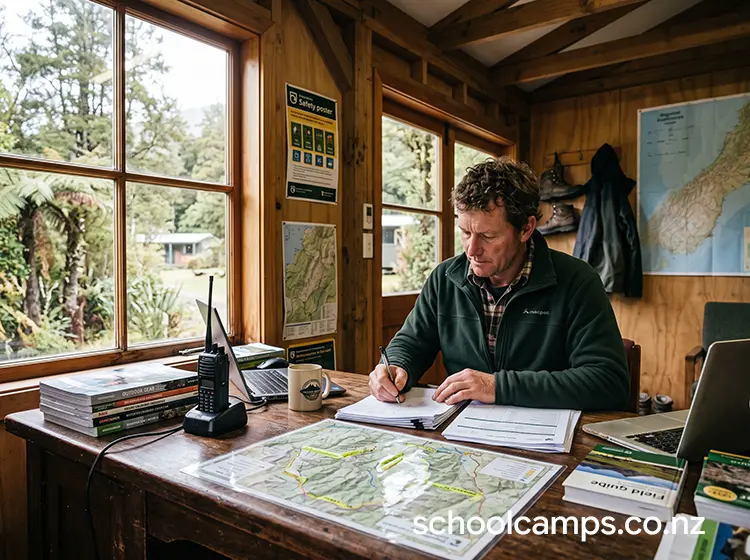
Key controls: a genuine training expedition completed before the qualifying trip; a detailed route card and itinerary lodged with the school and a home contact before departure; conservative daily distances with built-in contingency days where the itinerary allows; a Personal Locator Beacon or satellite communicator carried by every group, tested and understood before departure; clear check-in protocols (radio schedule, hut book sign-in, or a set daily contact time); an agreed emergency and bail-out plan for every leg of the route.
Roles on the day: a designated decision-maker per group (often a rotating student role under adult oversight) with a clear escalation path to the accompanying adult or assessor; a first aid carrier with a comprehensive kit; a communication carrier responsible for the PLB or satellite device; a base contact at school who holds the full itinerary and knows exactly when to raise the alarm if a check-in is missed.
When to stop or switch plans (red flags)
Stop immediately if: a severe weather warning is issued for the route area; any student shows signs of hypothermia, significant injury, or is deteriorating faster than the group can manage; the group misses a scheduled check-in; a planned river crossing looks unsafe; the group falls significantly behind the route card with no safe way to make up time before dark.
Switch to Plan B if: conditions are marginal (a wet but not dangerous day); the group is moving slower than planned (use a pre-identified bail-out point to shorten the route); one student needs to withdraw (the pre-planned single-person extraction route is used, never an improvised one).
What a safe expedition looks like
- ✓ A genuine training expedition was completed before the qualifying trip
- ✓ A detailed route card and itinerary is lodged with the school and a home contact
- ✓ Every group carries a tested PLB or satellite communicator and knows how to use it
- ✓ Check-ins happen on schedule, with a clear plan for what happens if one is missed
- ✓ Daily distances are conservative, with contingency built into the schedule
- ✓ Students understand and can articulate the plan if something goes wrong
7. Site Selection and Conditions
What makes a location suitable: a route matched to the group’s DofE level and demonstrated ability from the training expedition; a mix of hut and campsite options with realistic daily distances between them; reliable water sources along the route; at least one safe bail-out or shortcut option per day; a route within a Mountain Safety Council or DOC-documented area with known conditions.
Deal-breakers: routes with mandatory unbridged river crossings that are prone to flooding; areas with no PLB/satellite coverage combined with no realistic road-access bail-out; routes significantly beyond what the training expedition demonstrated the group could handle.
Travel time and logistics: allow a full day for travel to and from a genuinely remote route; confirm hut bookings well in advance during peak season (November–April); factor in vehicle relocation if the route isn’t a loop.
Toilets, shelter, water access: DOC huts provide the most reliable shelter and water access; tent-based routes need a clear water source plan for each night; know the toilet/hygiene plan for the whole route in advance.
“Plan B” locations: a shorter, easier route within the same general area that still meets the DofE distance/night requirement at a lower risk level; if weather closes the planned route entirely, a pre-identified alternative route with a similar profile.
8. Session Structure Teachers Can Follow
This outlines a typical 2-night expedition structure: adjust for Silver/Gold durations.
Pre-departure (weeks before): training expedition completed; route card finalised and lodged; gear check for every student; final weather check.
Day 1: early departure; group briefing at the trailhead covering the day’s route, hazards, and check-in plan; steady pace to the first camp/hut, arriving with daylight to set up; evening check-in via PLB/satellite device or hut book; group meal and gear sort for the next day.
Day 2: morning weather and route check; navigation responsibility rotated among students under supervision; regular short stops for water and regrouping at junctions; arrival at the second camp/hut with time to rest before dark; evening check-in and debrief of the day.
Final day: shorter final leg to the exit point; full gear and headcount before departure; return travel.
Post-expedition (within a few days): full debrief (see How to Debrief Outdoor Experiences); for DofE participants, the reflection and assessor sign-off process required for the award.
9. Behaviour Management
For strategies on managing risk-takers, refusers, disengaged students, and creating positive reinforcement outdoors, see Behaviour Management Outdoors. Multi-day group living adds a specific challenge: interpersonal friction that builds over several days rather than a single session: plan for a check-in point partway through where the group can air and resolve minor tensions before they compound.
10. Reflection and Debrief
For debrief frameworks, facilitation tips, curriculum links, and reflection techniques, see How to Debrief Outdoor Experiences. For Duke of Edinburgh’s Hillary Award participants, the post-expedition reflection also forms part of the formal assessment: build in time for this specifically, not just a general camp debrief.
11. Common Issues and Fixes
Weather over multiple days
Issue: forecast deteriorates after departure. Fix: use the pre-agreed bail-out point for the day rather than pushing on and hoping conditions improve: a shortened, safely completed expedition still counts toward DofE requirements in most cases; check with your assessor.
Issue: gear gets wet on day one and can’t fully dry overnight. Fix: this is why a full spare set in a dry bag is non-negotiable: plan clothing rotation from the start rather than treating wet gear as an emergency.
Fatigue and morale
Issue: a student is significantly more tired than the group by day two. Fix: redistribute their pack weight among the group, adjust pace, and reassess whether the planned distance for the remaining days is realistic: better to shorten than to push a struggling student further.
Issue: group friction develops over shared chores or decisions. Fix: use the scheduled check-in point to surface and address it directly rather than letting it fester; rotating roles daily from the outset reduces this significantly.
Navigation and logistics
Issue: the group falls behind the route card. Fix: reassess against the day’s turnaround/bail-out time: use the pre-planned shorter option rather than trying to make up time by rushing.
Issue: a missed check-in. Fix: the base contact follows the pre-agreed escalation plan exactly as written: this is precisely why that plan needs to exist before departure, not be improvised in the moment.
Gear failures
Issue: a stove or key piece of shared gear fails. Fix: groups should carry basic repair items and know a backup cooking method (a second, simpler stove, or a plan for cold meals for one night) rather than treating this as an emergency.
12. Activity Variations and Extensions
Easier version (training/introductory): a single overnight trip at a hut close to road access, used specifically as the DofE training expedition or as a first multi-day experience before committing to a full qualifying journey.
Standard version: a Bronze or Silver-level DofE qualifying expedition with a well-established route and conservative daily distances.
Challenge version: a Gold-level expedition with genuine remoteness and navigation demand, or a non-DofE school expedition designed as a capstone experience for senior students, potentially including a self-sufficient cooking and navigation component with minimal adult intervention within the supervision framework.
13. Cost and Resourcing Notes
What tends to drive cost:
| Cost driver | Typical range |
|---|---|
| Qualified expedition supervisor/assessor | $400–$700 per day |
| DofE registration and award fees | Set by [Duke of Edinburgh’s Hillary Award NZ](https://dofehillary.org.nz); check current fees |
| Hut fees (DOC backcountry huts) | Typically $5–$25 per person per night |
| Group gear hire (tents, stoves, PLBs) | $15–$40 per item per day |
| Transport, including any vehicle relocation | $400–$900 depending on distance and route shape |
Ways to keep it affordable: running the DofE programme through the school’s own accredited leaders once trained, rather than an external provider for every expedition; choosing hut-based routes over full camping kit to reduce gear hire; staggering equipment purchases (PLBs, tents) across multiple years as a standing camp asset rather than hiring every time.
Estimated total costs per student: teacher-led expedition with school-owned gear, $60–$120 per student; provider-supported expedition, $150–$300 per student depending on duration and remoteness.
14. Next Steps for Schools
Ready to bring multi-day tramping or the Duke of Edinburgh’s Hillary Award to your students? Here’s your checklist:
- Check readiness: confirm students have solid day-walk experience first (see Tramping and Bush Walks) and assess your staff’s qualifications against the EOTC high-risk activity requirements.
- Register for the award (if applicable): contact Duke of Edinburgh’s Hillary Award NZ to register your school and understand current requirements for each level.
- Confirm route and training expedition: select a route matched to the group’s level, and schedule a genuine training expedition before any qualifying trip.
- Brief parents: use the template in Parent Communication for Land-Based Activities, with activity-specific consent covering the full itinerary.
- Book a provider (if using external instruction): contact providers such as Hillary Outdoors well ahead of your planned dates, particularly during peak season.
- Lodge the route card: finalise and lodge the detailed itinerary and check-in plan with the school and a home contact before departure.
Leave a Reply
You must be logged in to post a comment.